
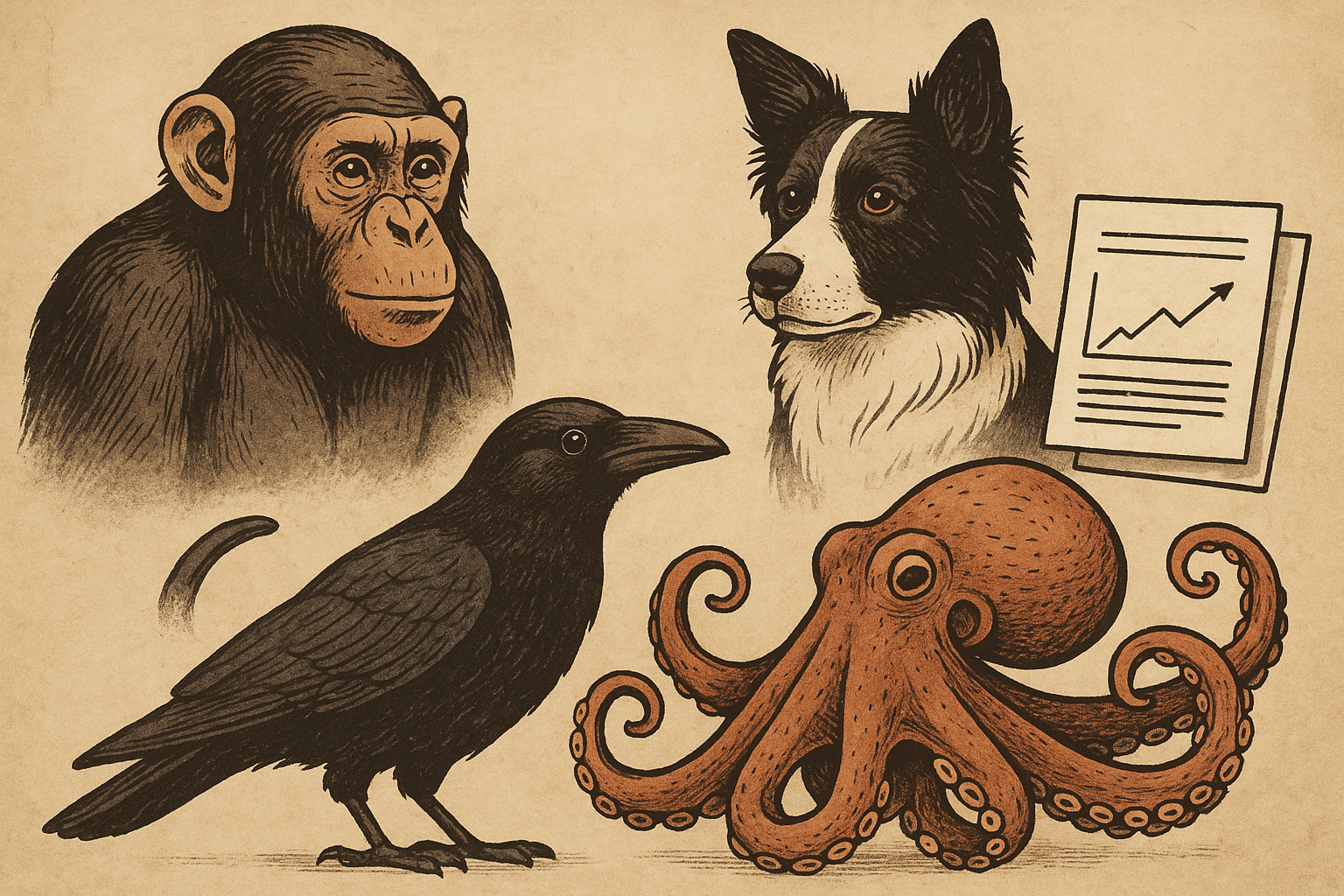
For centuries, people believed animal intelligence was limited, predictable, and inferior to human intellect. But modern science tells a very different story—one that is richer, more surprising, and far more humbling. If you think animals act only on instinct or lack complex emotions, new research will change how you see the entire animal kingdom.
Today’s scientists use advanced tools—from AI-powered behaviour analysis to brain-mapping technology—to uncover extraordinary abilities in species once dismissed as “simple.” Birds that plan for tomorrow, fish that use deception, dogs that understand hundreds of words, and octopuses that solve mechanical puzzles all challenge long-held misconceptions. This article explores ten powerful myths—and the cutting-edge research that proves them false.
Introduction
For a very long time, Western scientific tradition described animals as instinctive creatures with predictable reactions. Philosophers like Descartes even suggested animals could not think or feel, arguing they were biological machines lacking consciousness. This perspective shaped global attitudes toward farming, wildlife management, and the treatment of domestic animals.
However, the past four decades have produced a revolution in animal cognition research. Advances in neurobiology, behavioural science, evolutionary ecology, and artificial intelligence have revealed astonishing new insights. Scientists now document:
- tool innovation in birds and sea mammals
- social strategies in fish and insects
- memory systems rivaling human capabilities
- emotional responses similar to empathy, grief, and joy
- complex communication systems beyond simple calls
- planning abilities once thought uniquely human
These findings force us to rethink what “intelligence” truly means. Instead of seeing cognition as a ladder with humans at the top, researchers now view it as a multidimensional landscape where different species evolve unique cognitive strengths based on their environment, survival needs, and social structures.
This article takes a deep dive into 10 of the most persistent myths about animal intelligence—breaking down each misconception with historical context, scientific evidence, landmark experiments, and real-world examples.
Myth 1: “Animals Act Only on Instinct”
Background of the Myth
The belief that animals rely purely on instinct dates back centuries. Early thinkers observed predictable behaviours—migration, nest-building, mating displays—and assumed animals functioned like pre-programmed machines. Because animals cannot explain their thoughts verbally, humans assumed there were none.
During the Industrial Age, the rise of mechanistic scientific thinking reinforced the idea that animals behaved automatically, without conscious processing. This myth persisted well into the 20th century.
What Science Shows Today
Modern studies in comparative cognition reveal that animals rely on a combination of:
- instinct
- learned behaviour
- social learning
- environmental adaptation
- individual problem-solving
- innovation
Animals are not rigid systems. They adjust. They experiment. They learn from failure. They observe others and change strategies based on context.
Key Research Breakthroughs
1. Crow Intelligence
Crows and ravens solve multi-step puzzles requiring foresight, working memory, and innovation.
Examples include:
- bending wires into hooks
- using stones to raise water levels (Aesop’s fable task)
- combining multiple tools into a single functional device
These behaviours cannot be explained by instinct alone.
2. Rodent Cognitive Flexibility
Rats navigating mazes demonstrate:
- spatial memory
- the ability to choose alternative routes
- improvisation when obstacles appear
- learning from previous errors
MRI scans reveal that rat hippocampi process spatial maps similarly to human memory systems.
3. Primates Adjusting Social Tactics
Chimpanzees strategically form alliances, trade favours, and observe group hierarchies. This requires:
- reasoning
- emotional intelligence
- long-term memory
- strategic decision-making
Why This Matters
Understanding animals as thinking beings transforms how we approach conservation, welfare, and ethical treatment. Instinct alone cannot explain their flexible, context-driven behaviours.
Myth 2: “Only Humans Use Tools”
Historical Basis
For centuries, tool use was considered the defining human trait. Many anthropology theories were built around the idea that humans became human because we mastered tools.
This belief collapsed when Jane Goodall documented chimpanzees using sticks to fish for termites. Scientists initially resisted, arguing her findings were exceptions—but now, tool use is documented across dozens of species.
Scientific Evidence Across Species
Birds: Masters of Innovation
New Caledonian crows are among the world’s most innovative tool users. Research shows:
- they craft hooks from twigs
- shape leaves into barbed tools
- carry toolkits to different locations
- combine multiple objects to create longer implements
In many ways, their problem-solving rivals primates.
Marine Mammals
Dolphins in Shark Bay use sponges as protective tools when hunting along rocky sea floors. This behaviour is culturally transmitted—taught by mothers to offspring.
Sea Otters
Sea otters use stones as anvils to break open shellfish, demonstrating both tool use and problem-specific strategy.
Elephants
Captive elephants have used:
- branches to swat flies
- logs to stand on
- sticks to scratch unreachable areas
These behaviours indicate purposeful tool application, not instinct.
The Tool-Use Revolution
Today, scientists recognise that tools are one expression of intelligence—but not the only one. Many smart animals don’t use tools because their environments don’t require them.
Myth 3: “Animals Can’t Plan for the Future”
Origins of the Myth
The long-held belief was that only humans could imagine future scenarios. Early psychologists argued that animals lived in an “eternal present.” Without mental time travel, they were assumed incapable of planning.
Groundbreaking Research
Scrub Jays and Episodic-Like Memory
Scrub jays remember:
- what they stored
- where they stored it
- and when they stored it
They later retrieve food based on spoilage expectations—indicating future-oriented reasoning.
Apes Preparing Tools
Studies show chimpanzees:
- select tools in advance
- carry them for future use
- resist immediate temptations to prepare for later opportunities
This behaviour closely parallels human planning.
Corvid Behaviour
Ravens store food strategically based on future hunger patterns. They also hide food depending on whether potential thieves are watching, suggesting theory of mind.
Why This Matters
Planning indicates advanced cognitive processing once considered uniquely human, blurring distinctions between species.
Myth 4: “Language Is Uniquely Human, So Animals Cannot ‘Really’ Communicate”
Understanding the Myth
Humans indeed possess the most advanced language system—grammar, abstraction, symbolic thought. But this does not mean animals lack meaningful communication.
What the Research Shows
Dogs and Word Recognition
Border collies can learn over 1,000 words, categorise new objects, and follow two-step verbal instructions. Some understand verbs, nouns, and adjectives in combination.
Parrots Using Symbols
The African grey parrot “Alex” demonstrated:
- labelling colours, shapes, numbers
- identifying same vs different
- answering spoken questions
- showing comprehension beyond mimicry
His performance reshaped linguistic expectations for birds.
Ape Language Systems
Chimpanzees and bonobos trained with:
- lexigrams
- sign language
- symbolic boards
showed:
- basic grammar
- intentional communication
- inventing new combinations of symbols
Meerkats & Prairie Dogs
Wild meerkats and prairie dogs have predator-specific alarm calls. Prairie dog calls even encode details like:
- predator size
- colour
- direction of approach
- speed
This level of informational precision is extraordinary.
Conclusion on Communication
Animals may not have human-style language, but their communication systems are sophisticated, meaningful, and often learned—disproving the myth completely.
Myth 5: “Big Brains Mean Higher Intelligence”
Where This Myth Comes From
Historically, scientists measured intelligence by brain size relative to body size. This created a convenient hierarchy, placing humans at the top and many animals at the bottom.
The Reality: Brain Architecture Matters More
Bird Brains with High Neuron Density
Research shows corvids and parrots have:
- extremely dense forebrain neurons
- fast neural processing
- efficient communication pathways
They achieve primate-level reasoning with much smaller brains.
Octopus Intelligence
Octopuses have distributed intelligence:
- a central brain
- additional neural networks in each arm
- independent limb problem-solving
Some behaviour appears autonomous at the arm level, demonstrating a radically different form of intelligence.
Elephant Temporal Lobes
Elephants possess:
- enlarged brain regions for memory
- advanced emotional processing
- spatial mapping
Their cognitive architecture supports complex social behaviour.
The Scientific Shift
Rather than “brain size,” researchers now consider:
- neural density
- brain region specialisation
- connectivity pathways
- environmental adaptation
Intelligence is not about mass—it’s about design.
Myth 6: “Fish and Invertebrates Are Too Simple to Be Intelligent”
Why This Belief Exists
Fish lack facial expressions and invertebrates appear “primitive,” making their intelligence invisible to casual observers. Because their behaviours differ dramatically from mammals, humans misinterpret them.
Scientific Breakthroughs
Cleaner Fish and Social Strategy
Cleaner wrasse:
- remember previous interactions
- use deception strategies
- adjust behaviour depending on who is watching
- cooperate or cheat based on social monitoring
This requires advanced social cognition.
Bee Intelligence
Bees demonstrate:
- spatial navigation
- symbolic learning
- counting ability
- pattern recognition
- communication through the waggle dance
They operate highly efficient mental mapping systems in tiny brains.
Octopus Problem-Solving
Octopuses:
- open jars
- escape enclosures
- learn by observing
- manipulate objects with precision
- display individual personalities
In some experiments, they outperformed mammals traditionally considered more intelligent.
What This Means
Cognition evolved independently across species. Intelligence can emerge in small bodies, under different evolutionary pressures, in surprising forms.
Myth 7: “Animals Don’t Understand Numbers”
Historical Perspective
Because counting is a culturally developed human skill, early scientists assumed animals could not grasp numerical concepts.
What Research Reveals
Primates
Monkeys and apes:
- compare number quantities
- understand ratios
- use approximate number systems
- choose larger quantities during foraging tasks
Their numerical cognition resembles human infants.
Birds
Crows and pigeons:
- recognise quantities
- identify “three-ness” or “four-ness”
- generalise number rules to new situations
Bees
Remarkably, bees demonstrate:
- number discrimination
- simple arithmetic (addition & subtraction)
- landmark counting during navigation
Dogs
Dogs can distinguish between different numbers of treats—especially when the difference is large.
The Scientific Consensus
While animals don’t “count” like humans, many species show true numerical cognition that helps them survive.
Myth 8: “Emotions Are Uniquely Human”
Origins of the Claim
Earlier scientists avoided emotional language, worrying it would lead to anthropomorphism. As a result, emotional capacities in animals were ignored for decades.
Modern Scientific Findings
Dogs and Attachment
Dogs show:
- fMRI-verified attachment to humans
- joy responses to familiar scents
- stress responses to separation
Elephants and Grief
Elephants:
- mourn dead relatives
- revisit bones
- show protective behaviour around dying members
Primates Showing Empathy
Chimpanzees and bonobos:
- comfort distressed group members
- help unrelated individuals
- share food with emotionally troubled companions
Rodents Expressing Positive Emotions
Rats produce ultrasonic “laughter” during play and enjoy tickling in controlled experiments.
Emotions Are Not Exclusive
The emotional lives of animals may differ from humans, but they are real, measurable, and meaningful.
Myth 9: “Domestication Makes Animals Less Intelligent”
Where This Myth Begins
People often assume domesticated animals are “weaker” versions of their wild ancestors—more dependent, less capable, and cognitively diminished.
Scientific Findings
Dogs as Human-Communication Specialists
Dogs excel at:
- reading human gaze
- understanding pointing
- interpreting facial expressions
- responding to tone and emotional cues
These abilities surpass wolves, even when wolves are raised by humans.
Horses Communicating with Humans
Horses:
- signal for help
- interpret human body language
- solve shared communication tasks
Pigs & Social Strategy
Pigs:
- navigate mazes
- recognise individuals
- use mirrors to locate hidden food
Domestication selected for intelligence suited to human-centred environments—not less intelligence, but different intelligence.
Myth 10: “Intelligence Is a Ladder with Humans at the Top”
The Outdated Hierarchy
The ladder model assumes:
- humans are most intelligent
- others rank below based on similarity to humans
This view is no longer scientifically valid.
The Modern View: Cognitive Diversity
Intelligence is shaped by:
- ecological niches
- environmental demands
- sensory systems
- social structures
Examples:
- Clark’s nutcracker stores thousands of seeds and remembers their locations across seasons.
- Bats navigate through sound with remarkable spatial precision.
- Bees integrate multiple sensory inputs to travel miles efficiently.
- Elephants maintain complex social networks over decades.
These forms of intelligence outperform humans in specific domains.
Conclusion of the Myth
Intelligence evolved differently across species. There is no universal ladder—only a vast cognitive landscape filled with unique strengths.
7 FAQs
1. Why do misconceptions about animal intelligence persist?
Misconceptions persist because human societies have historically prioritised human abilities over those of other species. Many animals display intelligence in ways that are subtle, unfamiliar, or invisible to casual observers. Cultural traditions, outdated scientific beliefs, and limited exposure to animal behaviour also contribute. As a result, newer findings take time to reach public understanding. Only recently have modern tools and long-term research revealed how sophisticated animal cognition truly is.
2. Are some animals as intelligent as young human children?
In specific tasks, yes. Some primates, parrots, dolphins, and even crows perform at levels comparable to those of toddlers in areas such as memory, object permanence, counting, and symbol understanding. However, human children develop complex language and abstract reasoning that eventually surpass those of animals. The overlap exists only in specific domains, not across all capabilities. These comparisons help researchers understand how cognition evolves, but they do not imply full equivalence between species.
3. How do researchers measure intelligence without spoken language?
Scientists rely on behavioural tasks, controlled experiments, and neurobiological measurements. They observe problem-solving, decision-making, memory use, social interactions, and adaptability in natural and laboratory settings. Tools such as maze tests, puzzle boxes, touchscreens, AI behaviour tracking, and brain imaging allow precise measurement of cognitive processes. Long-term field studies also reveal cultural behaviours and learning traditions that words alone cannot express. Together, these methods create a strong picture of animal cognition.
4. Do all intelligent animals use tools?
No. Tool use is one expression of intelligence, but many highly intelligent species do not rely on tools because their environment offers no need. Dolphins, elephants, wolves, and many birds show sophisticated communication, planning, cooperation, and social strategy without constructing physical tools. Intelligence emerges in many forms—navigation, memory, emotional awareness, problem-solving, or social manipulation—depending on each species’ ecological demands.
5. Can animals be creative or do they only learn by imitation?
Many animals demonstrate creativity. Crows craft new tool shapes, dolphins invent unique play behaviours, and primates develop innovative feeding strategies. Innovation often appears when existing solutions fail or when animals explore new opportunities. While imitation is also common and important for cultural transmission, creativity shows that animals can go beyond copying to discover new methods independently.
6. How does recognising animal intelligence affect welfare?
Recognising intelligence reinforces the need for ethical treatment. Animals capable of emotion, memory, planning, and learning require environments that support mental stimulation and social needs. Understanding their cognitive abilities encourages better housing conditions, humane farming practices, enriched habitats, and improved conservation strategies. It also strengthens public awareness about the emotional and cognitive costs of poor welfare standards.
7. Will new technologies transform our understanding of animal intelligence?
Yes. Technologies like GPS tracking, drone observation, machine learning, neural implants, and automated behaviour analysis are revolutionising the field. These tools allow continuous, high-precision monitoring of animals in natural environments, revealing patterns previously impossible to detect. AI can uncover hidden social networks, subtle learning behaviours, and emotion-related signals. As these technologies advance, researchers expect major breakthroughs in understanding animal cognition.
Conclusion
Animal intelligence is not a narrow spectrum where humans sit at the top. It is a vast, multidimensional landscape shaped by millions of years of evolution. Birds, mammals, fish, and even insects possess remarkable cognitive adaptations that help them survive and thrive in complex environments. From planning and problem-solving to communication and emotional depth, their abilities are far richer than once believed.
As cutting-edge research continues to dismantle outdated myths, society gains a deeper appreciation of the minds that share our planet. Understanding animal intelligence is not merely a scientific pursuit—it is an ethical responsibility. By acknowledging their cognitive and emotional capacities, we can make more compassionate decisions, support stronger welfare practices, and protect the diversity of life that enriches our world.