
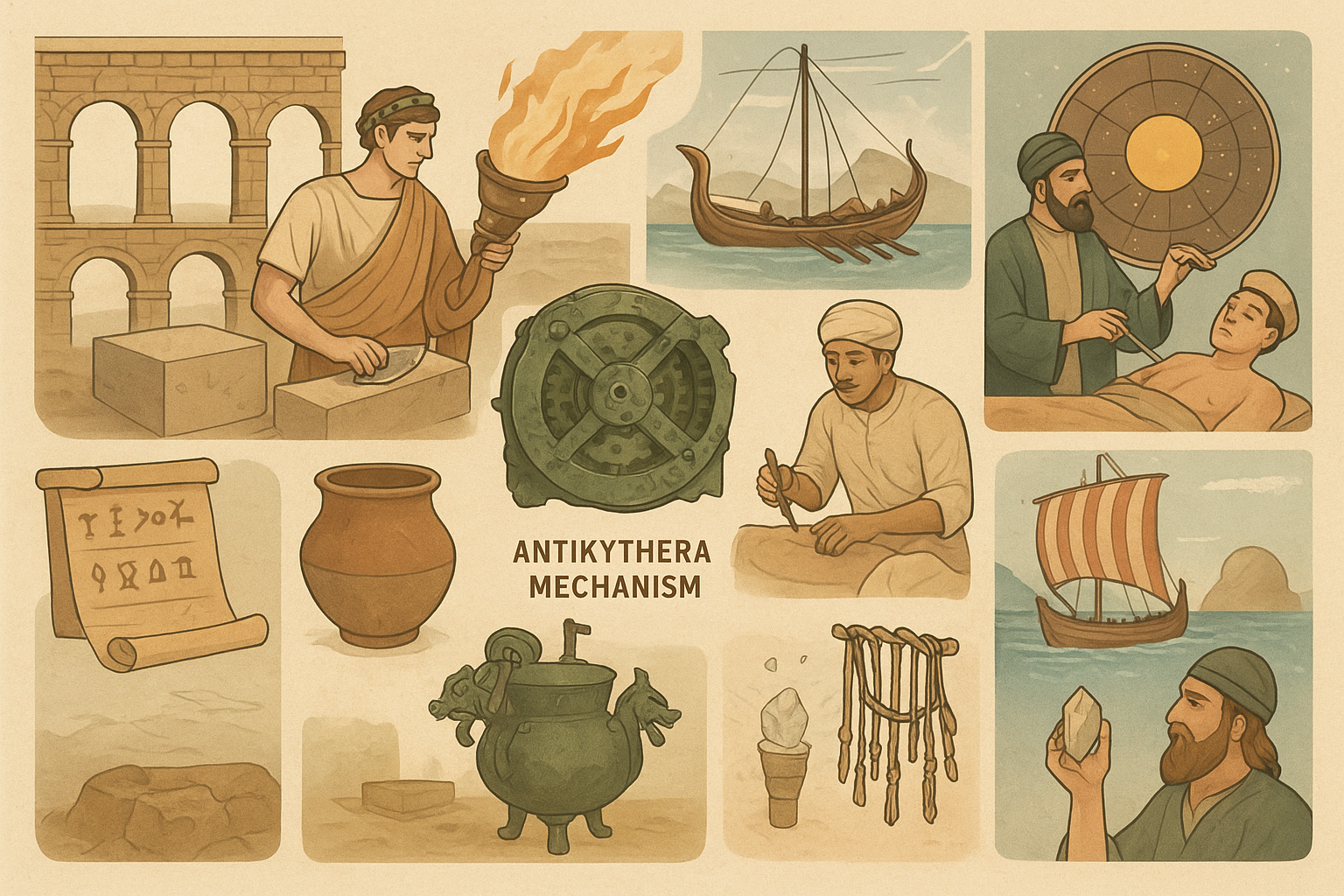
History isn’t just about dusty ruins and old scrolls—many forgotten ancient technologies still shape our modern world. From early surgical tools to water systems that rival today’s engineering, these inventions continue to influence how we live, work, and innovate. Let’s uncover 10 surprising facts about ancient technologies that remain relevant even in today’s high-tech age.
Introduction
When we think of technology, our minds often jump to smartphones, artificial intelligence, or space exploration. Yet, the foundations of these modern marvels often lie in ingenious innovations created thousands of years ago. Civilizations such as the Egyptians, Greeks, Romans, and Mayans developed technologies so advanced that they continue to inspire contemporary science and engineering.
These forgotten ancient technologies remind us that progress is built upon centuries of human curiosity and craftsmanship. From sustainable building materials to precision medical tools, ancient knowledge laid the groundwork for innovations that we now take for granted. Let’s journey back in time and explore how these technologies still influence modern life.
1. Roman Concrete – Stronger Than Modern Cement
Roman concrete is one of the most remarkable ancient technologies. Unlike modern concrete, which deteriorates over a few decades, Roman concrete structures have lasted for thousands of years. Its resilience comes from a mix of volcanic ash, lime, and seawater, which allowed the concrete to “heal” itself when cracks formed. Today, scientists and engineers are studying its composition to create eco-friendly, long-lasting construction materials. With the construction industry contributing heavily to carbon emissions, Roman concrete provides a model for sustainable, durable building. From bridges to marine structures, this ancient material continues to influence how we approach modern engineering.
- Still studied for sustainable construction
- More durable than modern concrete
- Eco-friendly compared to today’s cement
Did you know? NASA has studied Roman concrete for ideas to build durable structures on Mars.
2. Greek Fire – The Mysterious Weapon
Greek Fire was an extraordinary invention of the Byzantine Empire, feared and respected across naval battlefields. It was a flammable liquid that could continue burning even on water, giving the Byzantines a critical advantage at sea. The exact formula remains a mystery, as it was closely guarded and eventually lost to history. Many believe it combined petroleum, sulfur, and quicklime. Its influence is seen in modern incendiary weapons and flamethrowers. The concept of controlled chemical reactions for warfare and defense can be traced back to this forgotten weapon, proving that even destructive technologies shaped the course of innovation.
- Composition still unknown
- Inspired modern flamethrowers
- Used to protect Constantinople
Did you know? Historians believe Greek Fire may have involved petroleum, sulfur, and quicklime, but its formula was guarded so closely it was lost to history.
3. Antikythera Mechanism – The First Computer
The Antikythera Mechanism, discovered in a Greek shipwreck, is often called the first known computer. Dating back to 200 BCE, this intricate device used bronze gears to predict celestial movements, eclipses, and even the Olympic Games calendar. Its sophistication stunned scientists, as nothing comparable was built again for more than a thousand years. The mechanism demonstrates the depth of ancient knowledge in mathematics, astronomy, and mechanics. Today, it influences modern computing and astronomy, proving that human ingenuity in problem-solving is timeless. It highlights how the quest to understand the universe inspired early technologies that paved the way for computers.
- Built around 200 BCE
- Used gears similar to modern machinery
- Influenced astronomy and timekeeping
Did you know? The Antikythera Mechanism had over 30 bronze gears, a level of sophistication not seen again until medieval clockmaking.
4. Ancient Indian Surgical Tools – Ahead of Their Time
Ancient Indian medicine, particularly through the works of Sushruta, showcased extraordinary advancements in surgical techniques. Around 600 BCE, Sushruta documented hundreds of surgical tools, from scalpels to forceps, in his medical text, the Sushruta Samhita. He also described complex procedures like cataract removal and skin grafting. These practices emphasized precision, cleanliness, and patient care. Many of his methods spread across Asia and influenced medieval medical practices in Europe and the Middle East. Today, modern surgery still reflects his emphasis on hygiene and tool design. Ancient Indian surgical innovations remind us that modern medicine is deeply rooted in ancient wisdom.
- Detailed cataract surgery described
- Hundreds of surgical tools invented
- Emphasized hygiene and precision
Did you know? Sushruta’s texts inspired surgical advancements in the Middle East and Europe during the medieval period.
5. Mayan Water Filtration Systems
Centuries before modern filtration plants, the Mayans developed systems that used natural minerals like quartz and zeolite to purify drinking water. These minerals filtered out harmful bacteria and toxins, ensuring safe water for large urban populations. Archaeological studies at Tikal revealed evidence of these advanced filtration techniques, proving the Mayans’ deep understanding of natural science. Today, similar minerals are still used in modern water treatment plants. This ancient technology is a powerful reminder of how sustainable and innovative practices can provide clean water, one of the most vital resources for civilization.
- Early form of water treatment
- Still relevant in modern filtration
- Proof of advanced engineering
Did you know? Researchers at the University of Cincinnati found evidence of these filtration systems at Tikal, one of the largest Mayan cities.
6. Egyptian Papyrus – The First Paper
Long before the invention of modern paper, Egyptians created papyrus from the stems of Nile plants. This innovation revolutionized communication, record-keeping, and education. Unlike stone carvings or clay tablets, papyrus was lightweight, portable, and easy to store. It allowed for the spread of literature, religious texts, and administrative records, laying the foundation for information sharing. The word “paper” itself is derived from papyrus, showcasing its lasting impact. Today’s books, documents, and newspapers all trace their origins back to this invention, proving that one of the simplest technologies had one of the most profound influences on human history.
- Lightweight and portable
- Revolutionized record-keeping
- Foundation for education systems
Did you know? The word “paper” comes from “papyrus,” highlighting its lasting influence.
7. Chinese Seismograph – Detecting Earthquakes Early
Invented in 132 CE by Zhang Heng, the Chinese seismograph was a masterpiece of early engineering. This bronze vessel featured dragon heads holding balls that would drop when seismic activity was detected, indicating the direction of an earthquake. Remarkably accurate for its time, it provided early warning to communities, helping reduce disaster risks. This technology demonstrates how ancient civilizations understood natural phenomena and sought to protect their people. Modern seismographs are far more complex, but they follow the same principle of measuring ground movement. The Chinese seismograph proves that ancient science could be surprisingly advanced and life-saving.
- Bronze vessel with dragon heads
- Used pendulum motion
- Early disaster preparedness tool
Did you know? Some reconstructions of this device still work today, showing its reliability despite being nearly 2,000 years old.
8. Viking Sunstone Navigation
Viking seafarers braved treacherous oceans long before compasses existed. They are believed to have used sunstones, a type of crystal (Iceland spar), to locate the sun’s position even on cloudy or foggy days. By filtering polarized light, these stones allowed sailors to navigate with impressive accuracy. This technology explains how Vikings traveled vast distances across the Atlantic, reaching North America centuries before Columbus. Today, the principle behind sunstones influences optical instruments and navigation technologies. It’s an extraordinary example of how natural materials and observation skills were harnessed for exploration, shaping both ancient and modern maritime journeys.
- Allowed precise sea travel
- Natural polarizing crystal
- Inspired optical navigation tools
Did you know? Experiments show sunstones can locate the sun within a few degrees even when completely overcast.
9. Incan Quipus – Data Storage with Knots
The Incas, who lacked a written alphabet, developed quipus—cords with knots—to record census data, taxes, and even stories. These knots represented numbers and possibly encoded narrative information, making quipus a unique information storage system. They were portable, durable, and could be “read” by trained specialists called quipucamayocs. Some researchers believe quipus may have influenced binary coding systems, the foundation of modern computing. Quipus highlight how different civilizations found creative ways to manage information without writing, and their legacy still resonates in how we think about data, mathematics, and memory systems.
- Portable data recording tool
- Used mathematical coding
- Inspired binary coding theories
Did you know? Some researchers believe quipus may have encoded not just numbers but also stories and cultural knowledge.
10. Babylonian Astronomy – Mapping the Stars
The Babylonians were pioneers in astronomy, mapping stars and planetary movements with incredible accuracy over 3,000 years ago. They created the zodiac system and predicted lunar eclipses with mathematical precision. Their star charts influenced Greek and later Islamic astronomy, forming the basis of modern space science. Babylonian astronomers used geometry and time intervals to track celestial events, techniques still applied in modern astrophysics. Their ability to interpret the cosmos without telescopes shows their intellectual brilliance and curiosity. Modern astronomy, calendars, and even astrology owe much to these ancient observers of the sky.
- Predicted lunar eclipses
- Created zodiac system
- Foundation for modern astronomy
Did you know? Babylonian clay tablets from 3,000 years ago contained trigonometric methods still recognized by astronomers today.
FAQs
1. Why are ancient technologies important today?
Ancient technologies laid the foundation for many modern inventions. From medicine to construction, these early innovations provide insights into sustainable practices, durable materials, and human ingenuity. Studying them helps us understand cultural progress and inspires solutions for future challenges.
2. What is the most influential ancient technology?
Roman concrete and the Antikythera Mechanism are often cited as the most influential. Roman concrete shaped architecture, while the Antikythera Mechanism represents early computing. Both showcase how ancient engineering influenced modern science and technology across fields like construction, mechanics, and astronomy.
3. Did all ancient technologies survive to modern times?
No. Many technologies were lost due to wars, natural disasters, or secrecy. For example, Greek Fire’s formula vanished, while papyrus making declined with the rise of parchment and paper. However, rediscoveries and modern research continue to revive some forgotten methods.
4. How did ancient people create advanced technologies without modern tools?
Ancient innovators relied on observation, experimentation, and necessity. They used natural resources like stone, metal, and plants, coupled with mathematical knowledge, to build sophisticated tools and systems. Collaboration within communities also helped refine and pass down technologies through generations.
5. Can ancient technologies be used today?
Yes. Many are being re-examined for sustainable solutions. Roman concrete inspires eco-friendly construction, Mayan filtration methods inform water purification, and Viking navigation helps study natural optics. Reviving ancient methods can solve modern environmental and engineering challenges.
6. What role did ancient medicine play in shaping modern healthcare?
Ancient medical practices introduced surgical tools, herbal remedies, and hygiene principles. Indian, Egyptian, and Greek medicine laid the groundwork for modern surgery, pharmacology, and patient care. While not all practices were accurate, their principles influenced modern scientific approaches to healthcare.
7. How do historians rediscover forgotten technologies?
Historians use archaeology, ancient texts, and modern science to study forgotten technologies. Excavations reveal artifacts like tools, machines, or construction materials. Advanced techniques such as 3D scanning, chemical analysis, and experimental archaeology help reconstruct how these technologies worked and why they mattered.
Conclusion
Forgotten ancient technologies remind us that innovation is not just a modern phenomenon. Civilizations long gone developed techniques that solved problems in ways still relevant today. From eco-friendly concrete to intricate astronomical devices, their brilliance echoes through time, shaping the tools we use daily.
By studying and respecting these technologies, we gain more than knowledge of the past—we also discover inspiration for the future. In an era facing challenges like sustainability and global connectivity, ancient wisdom may provide answers hidden in plain sight.