
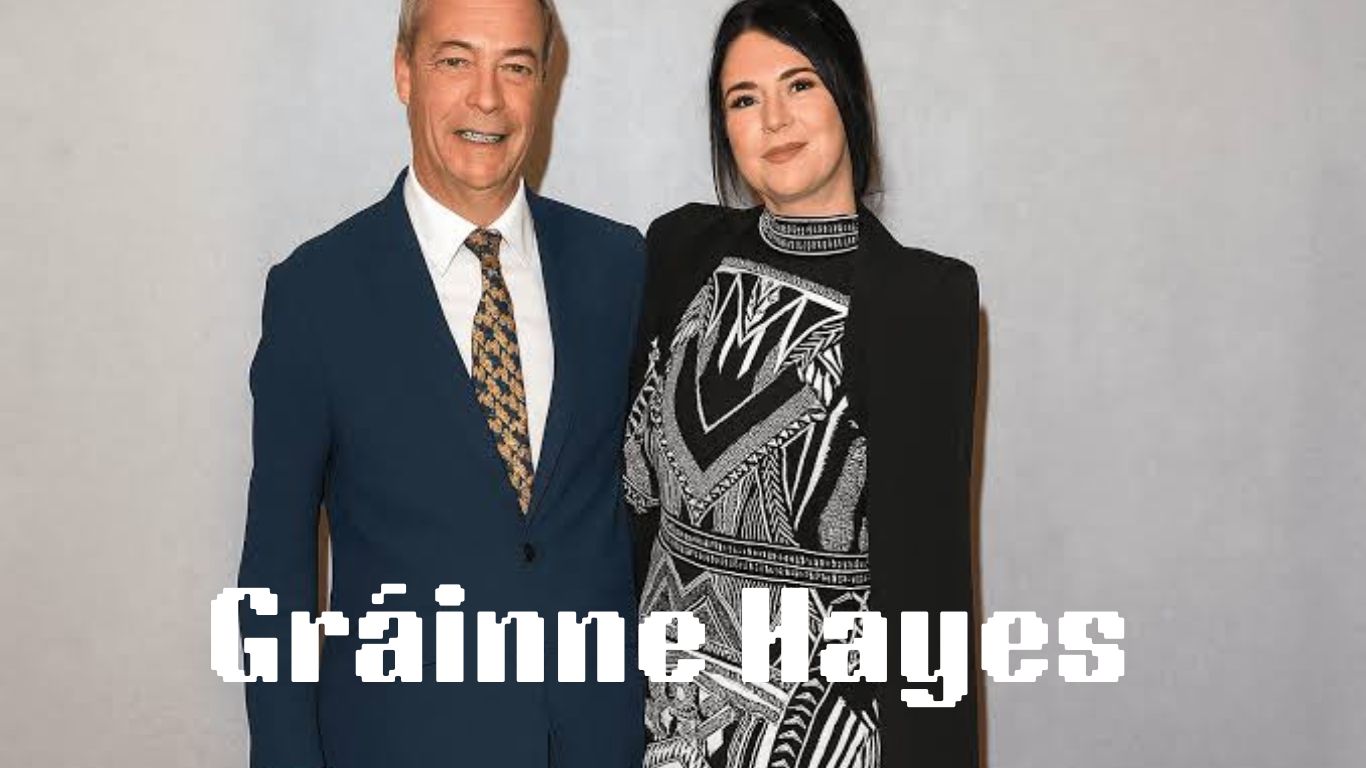
Nigel Farage has been one of the most divisive figures in British politics during the past thirty years. Farage’s public life has been thoroughly examined because he is the face of the Brexit movement and a well-known voice on talk shows. Beneath the speeches and soundbites, however, is a private life that has hardly been examined. His first wife, Gráinne Hayes, was present during some of his most formative years.
Gráinne Hayes played a crucial part in a period of Farage’s life that was characterised by near-death experiences, personal recovery, and the start of his family, despite the fact that she has mainly avoided the spotlight. In order to present Gráinne Hayes as a genuine person with her own life rather than as a political footnote, this article attempts to put together a truthful, respectful, and thorough biography of her.
Gráinne Hayes: Who Is She?
Although Gráinne Hayes is most recognised for being the first wife of Nigel Farage, her life story goes well beyond that. According to what is known to the public, Farage met an Irish nurse who was both capable and caring.
Gráinne Hayes, full name
Irish nationality
- At the time of meeting Farage, I was a nurse.
- 1988 saw the marriage to Nigel Farage.
- Children: Thomas and Samuel, two sons
- Divorce: 1997
Public life: private individual with no verified social media presence or public interviews
Her Irish Gaelic name, Gráinne (pronounced “Grawn-ya”), means “grain” or “love.” What little is known about her Irish ancestry is consistent with her heritage, which is reflected in the spelling with the fada accent.
Early Years and Experience
Gráinne Hayes never sought attention, in contrast to her well-known ex-husband. Information regarding her early years, including her birthplace, family history, and educational background, is kept confidential. The fact that she was employed as a nurse in the UK in the middle of the 1980s—a period when British hospitals actively sought out Irish medical professionals—is verified.
During this time, a large number of Irish women were employed, particularly in nursing positions, in London and the South East of England. In this setting, she met Nigel Farage, a young, bold commodities trader.
Although public records do not allow us to verify the hospital she worked at, reports and Farage’s own memories point to Bromley Hospital or a nearby South London medical facility. [Conclusion]
How Gráinne Hayes and Nigel Farage Met: A Crisis-Based Relationship
The dramatic and moving tale of Gráinne Hayes’s meeting with Nigel Farage starts with tragedy rather than romance.
Nigel Farage was hit by a car in November 1985 while he was only 21 years old and crossing a street close to Orpington, Kent. The mishap was disastrous. His head injuries were severe, and his left leg was so severely crushed that doctors pondered amputation. He endured both physical and psychological agony while lying in recuperation for months.
Gráinne Hayes came into his life during this time of vulnerability and suffering.
“I married the nurse who treated me,” according to Farage’s own statement, which was published in The Telegraph and reiterated in many credible publications. Gráinne Hayes was that nurse. Their relationship deepened as she supported him during his protracted recuperation.
Despite hardship, their relationship flourished. Farage would later claim that the encounter “changed everything,” both emotionally and physically. As a nurse, Gráinne Hayes stood for kindness, stability, and healing, traits that must have had a significant impact on the future politician’s formative years.
Family Life and Marriage (1988–1997)
In 1988, Nigel Farage wed Gráinne Hayes after a few years of dating. Farage was still employed in London at the time as a commodities trader. He was in his early twenties, she was a little older, and they were beginning their lives together in the shadow of his recuperation and rekindled ambition.
Nigel Farage and Gráinne Hayes: A Timeline
1964 – Nigel Farage is born in Kent, England.
1985 – Farage suffers a serious car accident and meets Gráinne Hayes during his recovery.
1986 – Farage is diagnosed with testicular cancer and undergoes treatment.
1988 – Farage and Hayes marry.
1989 – Their first son, Samuel, is born.
1991 – Their second son, Thomas, is born.
1993 – Farage joins UKIP and begins his political career.
1997 – Farage and Hayes divorce.
This decade marked a major transformation in Farage’s life, from a young commodities trader recovering from illness to a rising political figure.
The Meaning Behind Their Story
The relationship between Gráinne Hayes and Nigel Farage represents two powerful human themes: resilience and support.
For Farage, those years were shaped by survival, recovery, and ambition.
For Hayes, they represented compassion, care, and quiet strength.
Their marriage may have lasted less than a decade, but it covered some of the most important personal years of Farage’s life. Their story demonstrates that not every person who influences history appears in the headlines.
Public Interest and Media Responsibility
Because of her connection to a major political figure, Gráinne Hayes has occasionally been mentioned in biographies and articles about Farage.
However, much of the information available about her remains limited. Many online biography websites repeat the same basic details without providing verified sources.
Responsible reporting requires separating confirmed facts from speculation.
What is widely reported:
- She is Irish.
- She worked as a nurse.
- She married Nigel Farage in 1988.
- They had two sons.
- They divorced in 1997.
Beyond these details, much of her life has remained private.
Irish Identity and Contribution
Gráinne Hayes’s background also reflects the wider story of Irish healthcare workers who contributed to British society, particularly during the 1980s and 1990s.
Thousands of Irish nurses worked within the UK healthcare system during this period, becoming an important part of the NHS workforce.
Her personal story is therefore connected not only to Farage but also to a broader history of migration, healthcare, and contribution.
Privacy, Fame, and Personal Boundaries
Gráinne Hayes’s decision to remain private raises an important question: should everyone connected to a public figure become part of public discussion?
Her life suggests that privacy can be a deliberate and meaningful choice.
Unlike many people connected to famous individuals, Hayes has never sought media attention or used her relationship with Farage as a platform.
Her silence does not indicate a lack of importance. Instead, it reflects a decision to live outside the spotlight.
Frequently Asked Questions
Who is Gráinne Hayes?
Gráinne Hayes is an Irish nurse who was Nigel Farage’s first wife. The couple married in 1988, had two sons, and divorced in 1997.
How did Gráinne Hayes meet Nigel Farage?
They reportedly met after Farage’s 1985 car accident, when Hayes was involved in his care during his recovery.
Where is Gráinne Hayes now?
There is no verified public information about her current location or professional life. She has chosen to maintain privacy.
Did Gráinne Hayes remarry?
There is no publicly confirmed information about whether she remarried after her divorce from Farage.
Do Nigel Farage and Gráinne Hayes still communicate?
There is no public information regarding their current relationship or communication.
Lessons From Gráinne Hayes’s Story
Private strength matters
Supporting someone through illness, recovery, and personal transformation requires patience and resilience.
Influence does not always happen publicly
Not every important contribution appears in newspapers or history books.
Privacy can be powerful
Choosing a private life in a highly public world can be an expression of independence and self-respect.
Personal history adds context
Understanding the people who shaped public figures can provide a deeper view of their lives without invading personal boundaries.
Final Thoughts: A Silent Chapter in a Noisy Life
The tale of Nigel Farage and Gráinne Hayes is one of contrasts:
A politician and a nurse.
An Englishman and an Irishwoman.
A public provocateur and a private citizen.
Their paths crossed during a period of healing and vulnerability, developed into a marriage, and then parted ways as life took them in various places. Gráinne Hayes’s legacy exists in the private sphere of family, memory, and self-determination, while Farage’s voyage became public knowledge.
Ultimately, a person’s integrity—rather than their level of fame—is what defines their life. Gráinne Hayes has lived her life with calm grace, according to every narrative that is now accessible.