
Published: September 14, 2026
Last Updated: September 14, 2026
Tools Compared: 9
Pricing Last Checked: September 14, 2026
Managing Google Ads can become time-consuming long before a small business considers itself a large advertiser. Search terms need checking, budgets need watching, underperforming campaigns require attention, conversion tracking can fail, and automated bidding still needs sensible business inputs.
For small businesses, the best PPC Management Tools reduce some of that workload without taking away the control advertisers still need. However, these platforms solve very different problems. Some mainly identify issues, others let you approve fixes in one click, and a smaller group can execute predefined rules automatically.
Effective PPC advertising involves more than simply launching ads; businesses also need to manage budgets, targeting, performance data and ongoing optimisation. Pricing received particular attention because software that makes sense for an agency spending $500,000 per month may be difficult to justify for a local company spending $3,000.
Table of Contents
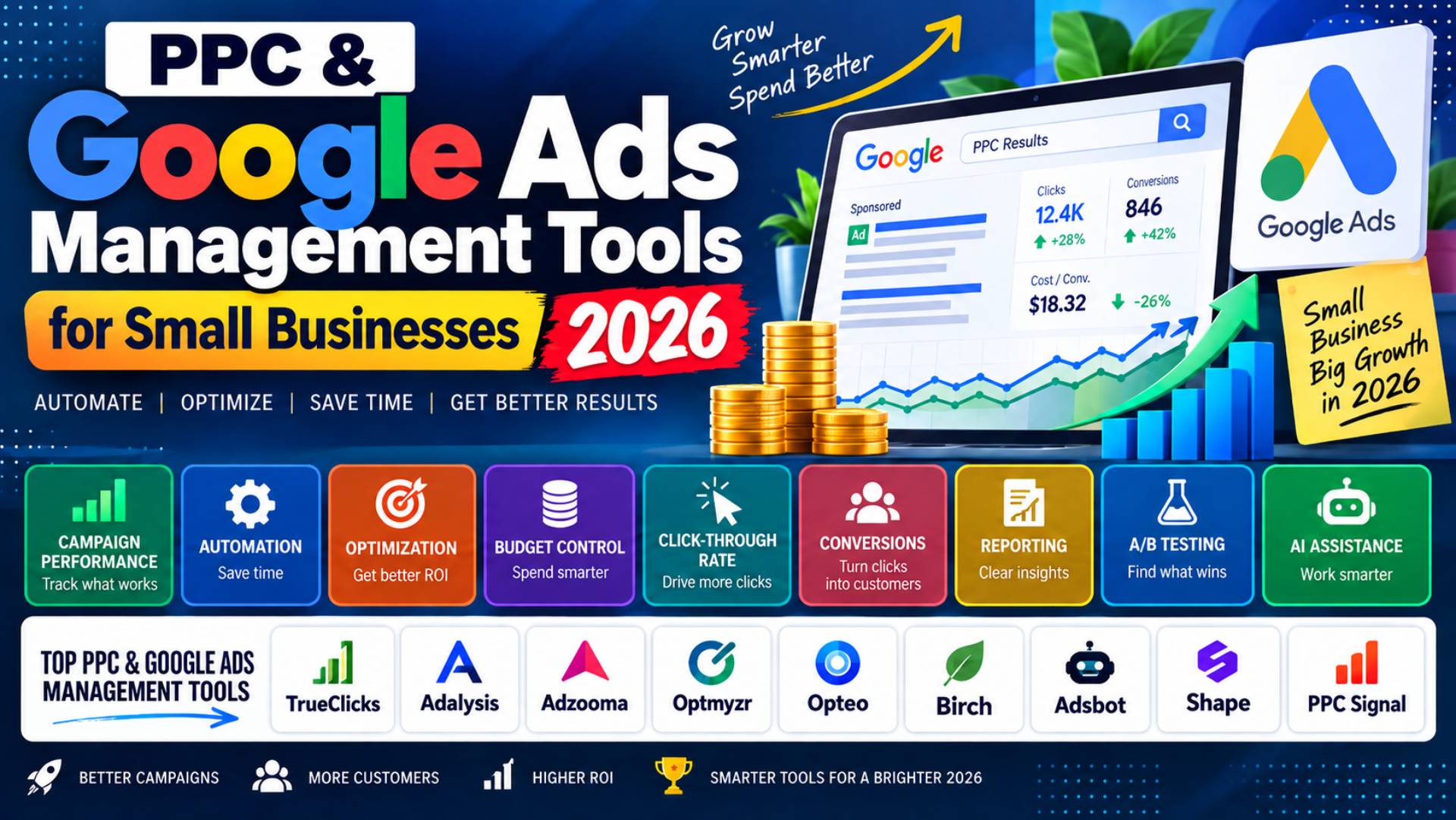
Best PPC & Google Ads Management Tools Compared
| Rank | Tool | Editorial Score | Best For | Typical Price |
|---|---|---|---|---|
| 1 | ✓TrueClicks | 8.8/10 | SMB PPC quality control | $0
|
| 2 | A
Adalysis |
8.7/10 | Deep optimisation and testing | About $126/mo*
|
| 3 | ◆
Adzooma |
8.7/10 | Affordable all-round management | $0
|
| 4 | ✓
Optmyzr |
8.7/10 | Advanced PPC teams | From about $299/mo
|
| 5 | O
Opteo |
8.3/10 | Google Ads simplicity | $129/mo
|
| 6 | B
Bïrch |
8.2/10 | Rule-based automation | $49/mo; Pro $99
|
| 7 | A
Adsbot |
8.2/10 | Affordable automation | $99/mo
|
| 8 | S
Shape |
7.5/10 | PPC budget management | One client free
|
| 9 | P
PPC Signal |
7.2/10 | Low-cost monitoring | $10/mo
|
Pricing may vary by plan, account size, advertising spend, or billing cycle. Check current provider pricing before purchasing.
Best PPC & Google Ads Management Tools: Our Top Picks
Best Overall: TrueClicks — Its free plan covers up to $50,000 in monthly ad spend while retaining all core features, including auditing, monitoring, optimization, budget pacing, and selected auto-apply automation.
Best for Detailed PPC Optimization: Adalysis — A deep Google and Microsoft Ads toolkit with more than 100 audit checks, 40+ PPC tools, Performance Max analysis, budget automation, ad testing, keyword tools, and rule-based actions.
Best Small-Business All-Rounder: Adzooma — A free entry tier, unlimited connected ad accounts, budget tracking, PPC alerts, recommendations, Google/Microsoft/Meta support, and paid plans from $69 per month make it approachable for smaller advertisers.
Best for Advanced PPC Teams: Optmyzr — One of the deepest platforms here for rules, budgets, PMax, cross-platform management, reporting, and advanced automation, but its higher price makes most sense once PPC complexity increases.
Best for Google Ads Beginners: Opteo — Its workflow centres on prioritised recommendations that users review and push to Google Ads, making the platform easier to understand than more technical rule engines.
Best for Flexible Rule Automation: Bïrch — Its Pro tier supports rules for Google Ads, Meta, TikTok, and Snapchat with automated bid, budget, pause/start, and scheduling actions.
Adalysis uses spend-based pricing. Its official page confirms the structure, unlimited Google/Microsoft accounts and users, while a current independent listing places entry pricing at $126 per month.
Scores shown are rounded to one decimal. Ranking order uses the underlying unrounded score.
Why Trust This Comparison
This guide does not assume that the product with the most features is automatically best for a small business. The assessment gives substantial weight to affordability, ease of use, pricing model, time savings, and whether a business with modest advertising spend can realistically justify the subscription.
The research also distinguishes between monitoring, recommendations, one-click implementation, rule-based automation, and autonomous management. That matters because PPC software vendors often use the word “automation” for very different capabilities.
No hands-on product tests were conducted. The comparison is based on current official documentation and pricing information checked in September 2026. Where official pricing was dynamically rendered or unclear, that limitation is disclosed rather than hidden.
How We Selected the Best PPC & Google Ads Management Tools
To qualify for our comparison of Google Ads Management Tools, a product needed to be active in 2026 and provide meaningful functionality directly related to Google Ads or PPC management.
We prioritised platforms offering one or more of the following:
- Google Ads auditing and monitoring
- Search-term and keyword analysis
- Negative keyword management
- Budget management
- Bid management
- PPC alerts
- Performance Max analysis
- Automated rules
- Optimization recommendations
- Reporting
- Multi-account management
General SEO platforms, CRM systems, generic AI assistants, and full-service PPC agencies were excluded unless PPC management software was a substantial part of the offering.
Small-business suitability also influenced selection. A specialised enterprise platform can be excellent software yet still be a poor recommendation for an owner-managed business spending a few thousand dollars per month.
How We Scored the PPC Management Tools
Each product was scored on a 10-point scale and weighted using the same formula.
| Criterion | Weight | What We Evaluated |
|---|---|---|
| PPC Management & Optimization | 20% | Breadth and depth of core PPC functionality |
| Automation & Time Savings | 15% | Actions the software can monitor, recommend or execute |
| Small-Business Value | 15% | Suitability relative to price and typical SMB needs |
| Ease of Use | 15% | Complexity, workflow and required PPC expertise |
| Google Ads Feature Depth | 10% | Search, PMax, keywords, bidding, budgets and related tools |
| Reporting & Analytics | 10% | Reports, dashboards, alerts and performance analysis |
| Pricing Transparency | 5% | Clarity and predictability of costs |
| Integrations | 5% | Ad networks and external systems |
| Support & Documentation | 5% | Help resources, onboarding and support access |
The final score is the weighted total of these categories. No hidden adjustment was applied after calculation. When products finished extremely close together, small-business value and ease of use were used as the tie-breakers because this article specifically targets SMBs.
What to Look for in PPC Management Software
Affordability
Price should be compared with monthly ad spend and management complexity. Paying $300 per month for software may be reasonable for a company spending $30,000 on paid search but difficult to justify for one spending $1,500.
Spend-based pricing also deserves attention. A platform can become more expensive as advertising activity grows even when your team uses the same features.
Ease of Use
The most useful PPC Tools for Small Businesses should save management time without creating a second system that requires extensive specialist knowledge. A small-business owner usually does not need an enterprise platform with hundreds of configuration options.
Google Ads Compatibility
“Supports Google Ads” can mean anything from read-only reporting to bid, budget, campaign, keyword, and negative-keyword management. Look at what the platform can actually read and change.
PPC Automation
For this comparison, automation is divided into five levels:
Level 1 — Monitoring: finds problems and sends alerts.
Level 2 — Recommendations: identifies risks or opportunities and suggests action.
Level 3 — Assisted Optimization: lets the user approve and push changes.
Level 4 — Rule-Based Automation: automatically executes predefined actions.
Level 5 — Autonomous Management: independently manages significant campaign decisions within configured limits.
None of the tools in this ranking was classified as full Level 5 autonomous account management across the entire Google Ads workflow based on the current public documentation reviewed.
Human Control
Automation needs safeguards. Preview modes, approval workflows, logs, minimum and maximum budget limits, and the ability to reverse changes become increasingly important as the software receives more control.
Performance Max Support
Google continues to make Performance Max a major AI-powered campaign type across Search, Shopping and other inventory. PMax uses Smart Bidding and can run across Search, YouTube, Display, Discover, Gmail and Maps.
A third-party tool therefore becomes more useful when it adds visibility, exclusions, asset analysis, search-term analysis or controls that complement Google’s own automation.
The 9 Best PPC & Google Ads Management Tools for Small Businesses in 2026
1. TrueClicks
Quick Snapshot
Editor’s Score: 8.8/10
Best For: Small businesses and PPC teams that want auditing, monitoring, optimization and waste prevention
Starting Price: Free up to $50,000 monthly ad spend
Paid Pricing: $249/month at the $100,000 spend plan
Free Trial: 30 days for paid plans
Google Ads: Yes
Microsoft Ads: Yes
Automation Level: Level 4 for selected auto-apply tasks
Key Strength: Exceptional free tier with the full feature set
Main Limitation: Less suited to businesses wanting broad autonomous campaign management
Pricing Checked: September 2026
Overview
TrueClicks earns first place because its pricing model is unusually favourable for small businesses. Companies managing no more than $50,000 per month in ad spend can use the platform free, with unlimited Google and Microsoft Ads accounts and the complete core feature set. Paid plans begin once managed spend moves above that level.
Its strength is not flashy campaign generation. It is systematic PPC quality control: automated audits, monitoring, budget pacing, KPI tracking, search-term analysis, waste detection and selected automated enforcement.
What Stood Out in Our Research
TrueClicks runs more than 100 audit checks and can identify issues involving conversion tracking, search partners, negative keywords, locations, account structure and PMax placements. Findings are prioritised rather than presented as an undifferentiated task list.
Its free tier is particularly unusual because features are not heavily stripped back. The main restriction is the $50,000 monthly managed-spend ceiling and support/onboarding differences.
Key Features
TrueClicks combines automated auditing with daily monitoring, budget pacing and in-platform fixes. Its n-gram and search-query tools can help identify wasted search spend, while PMax placement tools can identify and automatically exclude unwanted channels or websites.
It also offers integrations for external reporting tools and, in 2026, an MCP connection that lets compatible AI platforms query TrueClicks plus linked Google, Microsoft and Meta advertising data. The MCP connection itself is read-only.
PPC Automation: What Does It Actually Do?
TrueClicks should not be mistaken for a fully autonomous PPC manager. Its automation is narrower and more controlled.
Users can configure selected auto-apply tasks covering account settings, campaign settings, negative keyword lists, placement exclusions and other predefined controls. Each task can remain in preview mode until the advertiser is comfortable allowing it to run automatically.
That puts TrueClicks at Level 4 for specific rule-based enforcement, but not Level 5 account management.
Pricing and Value
The strongest small-business proposition is straightforward: $0 for up to $50,000 in monthly ad spend. Above that, the current $100,000 spend tier costs $249 per month. TrueClicks also offers discounts for six-month and annual billing.
For an SMB below the free-plan threshold, few competitors match its price-to-functionality ratio.
Pros
- Free with all major features up to $50,000 monthly spend
- Unlimited Google and Microsoft Ads accounts
- 100+ audit checks
- Strong search-term and waste-prevention tools
- Useful PMax placement controls
- Preview and auto-apply modes
Cons
- Automation is deliberately narrower than advanced rule engines
- Primarily focused on Google and Microsoft paid search
- Paid tier jumps to $249 once the free spend threshold is exceeded
Best For
Small businesses that want a continuous PPC audit and monitoring layer without paying another monthly software bill.
Avoid If
Choose another product if your main requirement is complex bid, budget and campaign automation across several advertising networks.
Editor’s Verdict
Among the best Google Ads Tools for 2026, TrueClicks stands out because its free tier removes the usual trade-off between price and useful functionality. It is particularly strong for businesses that want fewer account mistakes, tighter budget control and systematic waste prevention. Optmyzr or Adalysis provides deeper automation, but TrueClicks is the easier value decision for many SMB advertisers.
2. Adalysis — Best for Deep PPC Optimization and Testing
Quick Snapshot
Editor’s Score: 8.7/10
Best For: Businesses that want deep Google/Microsoft Ads analysis and rule automation
Starting Price: Approximately $126/month according to current independent pricing data
Pricing Model: Spend based
Free Trial: 30 days on the entry plan
Google Ads: Yes
Microsoft Ads: Yes
Automation Level: Level 4
Key Strength: Exceptional depth across auditing, ads, search terms and PMax
Main Limitation: More complex than simpler SMB tools
Pricing Checked: September 2026
Overview
Adalysis is one of the most complete paid-search management platforms in this comparison. Its current feature set includes more than 100 audit checks, 40+ PPC tools, budget automation, search-term analysis, Quality Score analysis, RSA management, bidding tools, campaign building, Performance Max tools and reporting.
Its biggest advantage over simpler systems is depth. Rather than focusing on one-click recommendations alone, it provides the tools experienced PPC managers need to investigate and standardise account management.
What Stood Out in Our Research
Adalysis has invested heavily in areas where Google’s automation can reduce visibility. Its 2026 AI Max tools, for example, analyse search-term expansion, advertiser-created versus automatically generated assets, and URL expansion behaviour.
Performance Max auditing, keyword analysis, automated ad testing and rule-based actions make it particularly useful for businesses where PPC has moved beyond basic campaign maintenance.
PPC Automation: What Does It Actually Do?
Adalysis qualifies as Level 4 rule-based automation. Its rule engine lets users customise prebuilt rules or create their own, while its budget system supports daily adjustments, rollovers and rule-based campaign pausing or reactivation.
That still does not mean the platform independently decides the overall PPC strategy. Users configure what should happen and under which conditions.
Pricing and Value
Adalysis bases pricing on total managed ad spend. Its official page confirms unlimited Google Ads accounts, Microsoft Ads accounts and users on all plans, along with a 30-day entry-level trial. Six-month billing saves 10%, while annual billing saves 15%.
Because the vendor’s dynamic slider does not expose all prices cleanly in the accessible page, a current Capterra listing places the entry price at $126 per month.
Pros
- More than 100 PPC audit checks
- Strong Performance Max and AI Max analysis
- Rule-based automation
- Advanced keyword and search-term tools
- Automated ad testing
- Unlimited Google/Microsoft accounts and users
Cons
- Higher learning curve than recommendation-first tools
- Google and Microsoft focus rather than broad social-ad management
- Spend-based pricing rises with account size
Best For
Small and mid-sized businesses with a knowledgeable marketer who wants more control than a simple recommendation dashboard provides.
Avoid If
Skip it if you want the cheapest possible monitoring tool or have very little PPC expertise.
Editor’s Verdict
Adalysis is one of the strongest pure PPC platforms here. It narrowly misses first place because TrueClicks is much easier to justify financially for sub-$50K advertisers, but experienced SMB marketers may find Adalysis materially more capable.
3. Adzooma — Best Affordable All-Rounder
Quick Snapshot
Editor’s Score: 8.7/10
Best For: Small businesses wanting broad PPC management at low cost
Starting Price: $0
Silver: $69/month
Gold: $179/month
Google Ads: Yes
Microsoft Ads: Yes
Meta Ads: Yes
Automation Level: Level 3–4 depending on workflow
Key Strength: Low entry price with multi-platform support
Main Limitation: Advanced automation is less clearly documented than specialist rule platforms
Pricing Checked: September 2026
Overview
For businesses comparing Small Business PPC Software, Adzooma has one of the most approachable pricing structures in the category. Its free plan includes unlimited connected ad accounts, monthly PPC reporting and opportunity analysis, three PPC alerts and budget tracking. Silver increases analysis frequency to weekly, adds custom alerts and unlimited users, while Gold moves reporting and opportunity analysis to daily.
The platform supports Google, Microsoft and Meta advertising, making it more useful for a small business running paid media across several networks.
What Stood Out in Our Research
Adzooma’s current product pages cover campaign auditing, budget tracking, Performance Max, Shopping, ad-copy analysis, conversion tracking, audiences, assets, targeting and bidding. Its Opportunity Engine uses account data to generate personalised recommendations that can be applied quickly.
It also deserves credit for clear free and paid pricing rather than forcing smaller advertisers through sales calls.
PPC Automation: What Does It Actually Do?
The current help centre clearly states that Automated Alerts monitor performance but do not change campaigns themselves.
Adzooma’s current fair-use policy still references the creation and execution of automation rules, while older public documentation describes automatic actions such as pausing campaigns or keywords. Because current product documentation places more emphasis on alerts and opportunities, we classify Adzooma conservatively as Level 3–4 rather than full Level 4 across every workflow.
Pricing and Value
The free plan is genuinely useful for basic monitoring. Silver costs $69 per month and Gold $179 per month, with discounted annual prices available.
That places Adzooma well below many specialist PPC suites.
Pros
- Useful permanent free plan
- Paid plans begin at $69/month
- Unlimited connected advertising accounts
- Google, Microsoft and Meta support
- PMax and Shopping tools
- Clear budget tracking and alerts
Cons
- Some automation documentation is less clear than specialist competitors
- Advanced PPC specialists may want deeper rule controls
- Free plan has limited opportunity-analysis and alert frequency
Best For
Owner-managed businesses and small teams looking for broad PPC oversight without a large software commitment.
Avoid If
Choose Optmyzr, Adalysis or Bïrch if complex rule logic and advanced automation are your main priorities.
Editor’s Verdict
Adzooma is one of the easiest products here to recommend to cost-conscious small businesses. It combines a usable free plan with sensible paid tiers and multi-network management. TrueClicks is stronger for rigorous PPC auditing, while Adalysis offers greater paid-search depth.
4. Optmyzr — Best for Advanced PPC Teams
Quick Snapshot
Editor’s Score: 8.7/10
Best For: Advanced advertisers, PPC specialists and growing agencies
Starting Price: Around $299/month on monthly billing; roughly $209/month annual equivalent at the entry tier
Free Trial: 14 days
Platforms: Google, Microsoft, Amazon, Meta, LinkedIn and Yahoo Japan Ads
Automation Level: Level 4
Key Strength: Extremely deep PPC management and automation
Main Limitation: High price for smaller advertisers
Pricing Checked: September 2026
Overview
Compared with simpler PPC Campaign Management Tools, Optmyzr is one of the most technically capable platforms in this list. Its current plans cover keyword and search-query optimisation, PMax insights, audits, reporting, budget optimisation, KPI alerts and a custom Rule Engine. Premium adds deeper automation, Shopping and feed management, multi-account budgets and reporting, competitor insights and other advanced functions.
The platform supports Google, Microsoft, Amazon, Meta, LinkedIn and Yahoo Japan advertising, giving it one of the broadest integration footprints here.
What Stood Out in Our Research
Optmyzr’s Rule Engine can make bulk changes to Google Ads based on custom conditions, while budget tools can monitor pacing and automatically modify budgets or pause campaigns.
Its Essentials tier also includes scheduled Rule Engine automation, although more frequent daily automation is reserved for Premium and above.
PPC Automation: What Does It Actually Do?
Optmyzr is clearly Level 4. Users define rules and strategies that can execute automatically on a schedule. It can automate budget actions, campaign changes and other repetitive PPC tasks.
It is not classified as Level 5 because advertisers still define the strategy and automation logic.
Pricing and Value
Optmyzr’s official pricing architecture varies by plan, spend and billing cycle, with 30% savings for annual billing. Current independent listings place Essentials at about $299/month on monthly billing and Premium at about $389/month.
Optmyzr itself currently describes pricing as starting at $209/month when comparing its annual entry price with TrueClicks.
For a very small advertiser, this is expensive. For a team managing several accounts or substantial spend, the feature depth may justify it.
Pros
- Very deep PPC workflow automation
- Strong PMax and Shopping support
- Advanced budget tools
- Broad advertising-platform support
- Powerful reporting and Rule Engine
- AI Sidekick and MCP access
Cons
- Expensive for low-spend SMBs
- More complexity than many owner-managed businesses need
- Spend-based pricing and plan differences require careful comparison
Best For
Growing companies with a dedicated PPC marketer or agencies managing several small-business accounts.
Avoid If
Skip Optmyzr if your monthly PPC budget is small enough that a $200–$300+ software subscription would materially reduce advertising spend.
Editor’s Verdict
Optmyzr is the strongest advanced platform in this ranking, but this is specifically a small-business comparison. Its price and complexity keep it below cheaper tools that solve the most common SMB problems with less overhead.
5. Opteo — Best for Simple Google Ads Optimization
Quick Snapshot
Editor’s Score: 8.3/10
Best For: Google Ads users who want clear recommendations rather than complex rules
Starting Price: $129/month
Basic Plan: 10 accounts / $25,000 monthly spend
Free Trial: 14 days
Google Ads: Yes
Automation Level: Level 3
Key Strength: Very clean recommendation-to-action workflow
Main Limitation: Primarily Google Ads focused
Pricing Checked: September 2026
Overview
Among Google Ads Optimization Tools, Opteo takes a simpler approach than Optmyzr or Adalysis. The platform continuously monitors Google Ads performance and creates prioritised “Improvements.” Users inspect the recommendation, review the supporting data and push approved changes directly to Google Ads.
That workflow is easy to understand and well suited to businesses that want software assistance without handing campaigns over to unattended rules.
Key Features
Opteo’s improvement types cover keyword management, ad creative, bidding, bad-traffic exclusions, Shopping and other recurring Google Ads tasks. Its newer N-Gram Finder also supports Search, Performance Max and Shopping analysis.
The platform includes spending controls, alerts, Slack notifications and branded scheduled reports.
PPC Automation: What Does It Actually Do?
Opteo is mainly Level 3 assisted optimization. It identifies changes and makes it easy to approve and push them.
That is deliberately different from a rule engine that runs unattended.
Pricing and Value
Basic costs $129 per month for up to 10 accounts and $25,000 monthly spend. Professional costs $249 for up to 25 accounts and $100,000 spend, while Agency costs $499. All offer a free trial.
Pros
- Clear and approachable interface concept
- 40+ improvement types
- Strong Google Ads reports
- Useful budget and performance alerts
- Direct one-click changes
Cons
- Less automation than rule-focused platforms
- Google Ads focus limits cross-channel use
- $129/month may still be high for microbusinesses
Best For
Small companies with someone actively managing Google Ads who wants help deciding what to change.
Avoid If
Choose Bïrch, Adsbot or Optmyzr if you specifically want unattended rule execution.
Editor’s Verdict
Opteo is one of the best choices for businesses that value simplicity over maximum automation. Its recommendation model keeps a human involved in every important change while still reducing the time required to analyse an account.
6. Bïrch — Best for Flexible Cross-Platform Rule Automation
Quick Snapshot
Editor’s Score: 8.2/10
Best For: Performance marketers who want flexible rules
Essential: $49/month at the displayed $10K spend level
Pro: $99/month at the displayed $10K level
Free Trial: 14 days
Platforms: Google, Meta, TikTok and Snapchat
Automation Level: Level 4
Key Strength: Flexible rule logic and frequent checks
Main Limitation: More automation-oriented than full Google Ads analysis
Pricing Checked: September 2026
Overview
Formerly known as Revealbot, Bïrch is built primarily around advertising automation. Google Ads rules can start or pause campaigns, change bids and budgets, duplicate items and send notifications. Rules can run as frequently as every 15 minutes depending on configuration.
Unlike Google-only products, Bïrch supports Meta, Google, TikTok and Snapchat automation through one platform.
PPC Automation: What Does It Actually Do?
This is clearly Level 4 rule-based automation.
Users define conditions, schedules and actions. Once live, Bïrch checks the selected advertising entities and executes configured changes when the conditions are met.
Bïrch therefore gives advertisers more execution power than a recommendation-first product, but it still depends on human-defined logic.
Pricing and Value
At the $10,000 monthly ad-spend setting shown on the current pricing page, Essential is $49 per month and Pro is $99. Automated rules and strategies are included in Pro. Bïrch offers a 14-day trial, and pricing scales according to connected ad spend.
For businesses interested specifically in automation rather than deep PPC auditing, $99 is competitive.
Pros
- Strong custom-rule automation
- Google, Meta, TikTok and Snapchat support
- Bid and budget actions
- Rules can run frequently
- 14-day free trial
- Useful for advertisers already comfortable with PPC strategy
Cons
- Pro required for automated rules
- Pricing increases with connected ad spend
- Less PPC-audit depth than Adalysis or TrueClicks
Best For
Experienced small-business marketers managing several channels and wanting to automate repetitive execution.
Avoid If
Avoid it if you need software to tell you what your PPC strategy should be rather than executing rules you define.
Editor’s Verdict
Bïrch is one of the best automation engines in this comparison. Its value increases when you already know the PPC rules you want implemented. Beginners may get more benefit from Opteo or Adzooma.
7. Adsbot — Best Affordable Rule Engine with AI-Assisted Analysis
Quick Snapshot
Editor’s Score: 8.2/10
Best For: Small teams wanting automation without Optmyzr-level pricing
Starting Price: $99/month
Pro: $199/month
Agency: $499/month
Automation Level: Level 4
Key Strength: Good combination of monitoring and rule execution
Main Limitation: Less established PPC depth than category leaders
Pricing Checked: September 2026
Overview
Adsbot combines campaign monitoring, recommendations, dashboards, automated reporting and a Rule Engine. Its Basic plan starts at $99 per month, while Pro costs $199.
Its Quick Insights functionality continuously scans advertising accounts for performance shifts, issues and optimisation opportunities, while recommended actions can be pushed directly to Google Ads.
PPC Automation: What Does It Actually Do?
Adsbot’s Rule Engine supports automatic actions including pausing ads or keywords, changing budgets, adjusting bids and adding negative keywords when predefined conditions are met. Rules can run hourly, daily or according to a custom schedule.
That earns a Level 4 automation classification.
Key Features
Adsbot currently combines:
- AI audits
- Quick optimization recommendations
- Rule-based campaign automation
- Multichannel dashboards
- Scheduled reporting
- Google Ads and Meta advertising workflows
Its own getting-started documentation also lists dozens of predefined automation rules.
Pros
- $99 entry price
- Strong rule engine
- Direct Google Ads actions
- Automated reporting
- Monitoring and recommendations in one product
- Multi-channel dashboard
Cons
- Smaller public ecosystem than established PPC platforms
- Basic plan is limited to one workspace and user
- Feature breadth may require more PPC knowledge than recommendation-led software
Best For
Small marketing teams that want a reasonably priced bridge between assisted optimisation and advanced rule automation.
Avoid If
Choose TrueClicks or Adzooma if free or low-cost monitoring matters more than automatic campaign actions.
Editor’s Verdict
Adsbot is a strong mid-priced alternative for companies that want real automation without moving immediately to Optmyzr’s price bracket. Its Rule Engine is the main reason it ranks above specialist monitoring products.
8. Shape — Best for PPC Budget Management
Quick Snapshot
Editor’s Score: 7.5/10
Best For: Businesses where budget pacing is the main PPC problem
Starting Price: One client can be set up free
Paid Plans: Pricing not clearly public; contact Shape
Automation Level: Level 4 within budget management
Key Strength: Excellent budget pacing and automation
Main Limitation: Specialist budgeting tool rather than full PPC optimizer
Pricing Checked: September 2026
Overview
Shape is different from the products above. Its strongest functionality is not keyword or ad-copy optimisation—it is budget control across PPC campaigns.
Users can group campaigns from multiple networks into common budgets, track pacing, receive alerts and automate actions designed to keep spend close to target. Shape supports Google, Microsoft, Facebook/Instagram, X/Twitter and LinkedIn as bidirectional data sources, with reporting-only support for some other platforms.
PPC Automation: What Does It Actually Do?
Shape’s automation includes AutoPilot and CruiseControl.
AutoPilot can pause campaigns when a budget target is reached or pause and re-enable them based on daily pacing. CruiseControl can adjust campaign daily budgets automatically within predefined minimum and maximum limits.
That is genuine Level 4 automation, but within a narrower budget-management remit.
Pricing and Value
Shape allows new companies to set up one client for free. Businesses requiring additional clients need a paid plan. The current help centre explains Starter/Pro/Enterprise structures but does not expose simple fixed paid pricing, so we do not assign an unverified figure.
Pros
- Strong budget pacing
- Automated budget changes
- Cross-platform campaign groups
- One client available free
- Useful for fixed monthly spend targets
Cons
- Paid pricing is not transparent
- Not designed as a complete PPC optimization suite
- Keyword, ad and search-term analysis are not its core strength
Best For
Businesses where staying within fixed client or departmental budgets is the main operational challenge.
Avoid If
Choose Adalysis, TrueClicks or Optmyzr if you need a full PPC optimization toolkit.
Editor’s Verdict
Shape is a specialist, not a general winner. For budget-sensitive advertisers, however, AutoPilot and CruiseControl solve a problem that many broader PPC tools handle less elegantly.
9. PPC Signal — Best Low-Cost PPC Monitoring Tool
Quick Snapshot
Editor’s Score: 7.2/10
Best For: Very small businesses wanting inexpensive Google Ads anomaly monitoring
Starting Price: $10/month
Free Trial: Available
Google Ads: Yes
Automation Level: Level 2
Key Strength: Very low cost
Main Limitation: Limited execution and platform breadth
Pricing Checked: September 2026
Overview
PPC Signal takes a much narrower approach than the other tools. It continuously analyses Google Ads data and identifies unusual positive or negative changes across metrics and dimensions.
Current pricing begins at $10 per month.
What Stood Out in Our Research
Signals are generated automatically and can identify changes in metrics such as cost, clicks or conversions across campaigns, ad groups, keywords, devices, geography and other dimensions.
It is essentially an inexpensive PPC early-warning system.
PPC Automation: What Does It Actually Do?
PPC Signal is classified as Level 2.
It automatically detects risks and opportunities and can recommend follow-up actions, but it does not have the same rule-based execution depth as Optmyzr, Bïrch, Adsbot or Shape.
Pros
- Starts at $10/month
- Easy concept for non-specialists
- Automatic anomaly and trend detection
- Google Ads-specific analysis
- Low financial commitment
Cons
- Limited campaign-execution automation
- Google Ads focus
- Much narrower management functionality
- Not a replacement for a complete PPC platform
Best For
Businesses that mainly want an inexpensive way to notice unusual Google Ads changes without adding a full management suite.
Avoid If
Skip it if you need automated rules, detailed multi-account management, deep PMax controls or cross-platform PPC workflows.
Editor’s Verdict
PPC Signal earns a place because $10 per month makes meaningful PPC monitoring accessible to very small advertisers. It ranks last because monitoring and analysis are only one part of PPC management.
Best PPC Tools for Different Small-Business Needs
| Need | Best Choice | Why |
|---|---|---|
| Best Overall | TrueClicks | Free under $50K spend with strong auditing and automation |
| Best Detailed Optimization | Adalysis | Deepest paid-search analysis and testing tools |
| Best Affordable All-Rounder | Adzooma | Free plan plus $69 paid tier |
| Best Advanced Platform | Optmyzr | Extensive rules, budgets and multi-platform management |
| Best for Beginners | Opteo | Clear recommendation-and-approval workflow |
| Best Rule Automation | Bïrch | Flexible scheduled campaign actions |
| Best Mid-Priced Automation | Adsbot | $99 entry point with a real Rule Engine |
| Best for Budget Pacing | Shape | AutoPilot and CruiseControl budget controls |
| Best Ultra-Low-Cost Monitor | PPC Signal | Starts at $10/month |
PPC Management Tool Pricing Compared
| Tool | Entry Price | Pricing Basis | Free Option | Trial |
|---|---|---|---|---|
| TrueClicks | $0 | Managed ad spend | Yes, up to $50K/mo | 30 days on paid tiers |
| Adalysis | About $126/mo | Managed ad spend | No | 30 days |
| Adzooma | $0 | Feature tier | Yes | Free plan |
| Optmyzr | About $299/mo monthly | Plan + managed spend | No | 14 days |
| Opteo | $129/mo | Accounts + spend | No | 14 days |
| Bïrch | $49/mo | Plan + connected spend | No | 14 days |
| Adsbot | $99/mo | Workspaces/users | No public free tier | Not clearly stated on pricing page |
| Shape | One client free | Spend/tier based | Yes, one client | — |
| PPC Signal | $10/mo | Accounts | No permanent free tier shown | Available |
Pricing comes from vendor pricing/help pages except where specifically noted for Adalysis and Optmyzr’s dynamically rendered entry figures.
What Does the Pricing Data Tell Small Businesses?
Businesses looking for Affordable PPC Management Solutions have three ongoing no-cost entry points in this comparison: TrueClicks, Adzooma and Shape. However, the scope, features and usage limits of their free options differ substantially, so price should always be considered alongside functionality.
At the opposite end, Optmyzr has the highest verified monthly entry price among the mainstream full-suite products in this comparison, which reinforces why it ranks better for advanced PPC teams than microbusinesses.
Price alone should not determine the winner. A $10 monitoring tool and a $300 automation suite are solving different problems.
PPC Management Features Compared
| Tool | PMax | Keywords | Budgets | Rules | Multi-Channel | |
|---|---|---|---|---|---|---|
| TrueClicks | ✓ | ✓ | ✓ | ✓ | ✓ | ◐ |
| Adalysis | ✓ | ✓ | ✓ | ✓ | ✓ | ◐ |
| Adzooma | ✓ | ✓ | ✓ | ✓ | ◐ | ✓ |
| Optmyzr | ✓ | ✓ | ✓ | ✓ | ✓ | ✓ |
| Opteo | ✓ | ✓ | ✓ | ✓ | ✕ | ✕ |
| Bïrch | ✓ | ✓ | ◐ | ✓ | ✓ | ✓ |
| Adsbot | ✓ | ? | ✓ | ✓ | ✓ | ✓ |
| Shape | ✓ | ◐ | ✕ | ✓ | ✓ | ✓ |
| PPC Signal | ✓ | ◐ | ✓ | ◐ | ✕ | ✕ |
The important lesson is that more automation is not automatically better.
A local business may prefer Opteo’s review-and-approve model because campaign changes remain visible. A skilled performance marketer may prefer Bïrch because the repetitive decisions have already been defined and can safely run as rules.
How the PPC Management Tools Compare
At the low-cost and simpler end sit PPC Signal, Adzooma and TrueClicks. They are easier to justify for modest advertising budgets.
In the middle, Opteo, Adsbot and Bïrch solve more specific workflow problems. Opteo prioritises assisted optimisation, while Adsbot and Bïrch move further toward automatic rule execution.
At the advanced end, Adalysis and Optmyzr provide much deeper PPC management systems. Shape sits somewhat outside this spectrum because it specialises heavily in budget management rather than the entire optimisation workflow.
A useful market-positioning graphic would therefore plot:
Horizontal axis: Simple → Advanced
Vertical axis: Low monthly cost → Premium monthly cost
Do Small Businesses Need a Third-Party Google Ads Management Tool?
Not necessarily.
Google Ads already contains substantial automation. Smart Bidding uses Google’s AI to optimise bids at auction time, and Performance Max automatically uses Google inventory across multiple channels according to campaign goals.
Google also provides automated rules. Advertisers can use them to change campaign status, budgets and bids, schedule promotions or trigger emails when conditions occur. Manager accounts can run rules across client accounts as well.
That means a small company running one straightforward campaign may not need third-party PPC software at all.
Third-party tools become more useful when you need:
- clearer auditing;
- easier search-term analysis;
- cross-platform reporting;
- more sophisticated rules;
- multi-account workflows;
- budget pacing;
- independent account checks;
- better alerts;
- easier client reporting;
- more visibility into PMax.
Before paying for third-party Tools for Managing Google Ads, identify what Google Ads is failing to do efficiently for your business. A separate platform makes the most sense when it solves a specific problem such as auditing, reporting, budget pacing, multi-account management or advanced automation.
How AI Is Changing PPC Management in 2026
AI already operates at several layers of PPC.
At the platform level, Google uses AI for auction-time bidding, conversion optimisation, Performance Max and ad delivery. In June 2026 Google also changed how some Smart Bidding strategy names are presented, although the underlying bidding behaviour did not change.
Third-party PPC platforms are part of a wider group of AI tools for small businesses that use automation to reduce repetitive work and improve decision-making.
PPC platforms increasingly overlap with broader marketing automation tools, especially where reporting, AI analysis and automated workflows connect advertising with other marketing activities.
- analysing account performance;
- detecting anomalies;
- identifying search-term themes;
- generating account summaries;
- prioritising recommendations;
- helping write ad assets;
- finding budget or bidding opportunities.
However, AI-assisted PPC is not the same as autonomous PPC management.
Most products reviewed here still depend on one of two models: a human approves the recommendation, or a human defines the rules the software later executes.
That distinction should matter more than whether a vendor simply labels a feature “AI-powered.”
Other PPC Management Tools We Considered
Several other products can be valuable but were not included in the main nine because they did not fit the article’s core SMB management criteria as closely.
Specialist click-fraud platforms such as ClickGuard can protect paid-ad budgets, but click-fraud protection is only one part of PPC management. ClickGuard’s current Lite plan starts at $74 per month for up to $5,000 spend and one PPC account.
Reporting-only platforms can also be useful, but they were excluded when they did not provide substantial PPC optimisation or management functionality.
The same approach applies to generic AI assistants. They may help analyse exported campaign data, but that alone does not make them a dedicated PPC management platform.
How to Choose PPC Management Software for a Small Business
1. Start With Monthly Ad Spend
A company spending $2,000 per month on Google Ads should scrutinise a $300 software subscription differently from a company spending $50,000.
At low spend levels, TrueClicks, Adzooma, PPC Signal or Google’s native tools are easier to justify.
As spend and account complexity grow, the time savings from Adalysis, Optmyzr or advanced automation may become more important than subscription price.
2. Decide How Much Automation You Want
If you want alerts only, there is little reason to pay for a complex rule engine.
If you want to review every recommendation, Opteo’s Level 3 approach may be more appropriate.
If you already know the conditions under which bids, budgets or campaign status should change, Bïrch, Adsbot, Adalysis or Optmyzr provide more suitable Level 4 functionality.
3. Consider Your PPC Experience
Automation cannot compensate for a poor strategy.
Beginners are often better served by tools that explain problems and recommendations rather than presenting dozens of rule-building options.
Advanced marketers generally receive more value from platforms that expose deeper controls.
4. Compare Software Cost With Potential Value
Software does not need to “save” its subscription cost purely by reducing ad spend.
Value can also come from:
- fewer manual checks;
- faster reports;
- earlier detection of broken tracking;
- less overspending;
- better account consistency;
- faster implementation;
- managing more campaigns without adding staff.
Do not assume these benefits guarantee a performance improvement. They depend on account quality and how the software is used.
5. Check Campaign-Type Support
Do not assume a tool that works well with Search has equally deep Performance Max or Shopping capabilities.
If PMax represents a large share of your budget, prioritise products with explicit current PMax functionality such as Adalysis, Adzooma, Optmyzr, TrueClicks and Opteo.
6. Review Reporting Requirements
An owner may need a simple monthly performance summary. An agency needs repeatable client reports, branding, scheduling and multi-account visibility.
Buying advanced reporting that nobody reads is wasted software spend.
7. Review Account Safety
As automation increases, check whether the platform provides:
- preview modes;
- rule logs;
- notification history;
- bid limits;
- budget limits;
- approval controls;
- change history.
Google itself recommends setting appropriate bid/budget limits and previewing automated rules before enabling them.
8. Consider Scalability
The cheapest tool today is not always the cheapest later.
Spend-based products can become substantially more expensive as advertising budgets grow. Account- or workspace-based pricing may scale differently.
Calculate future costs before committing your workflow to one platform.
Decision Guide
Choose TrueClicks if: you spend under $50,000 per month and want excellent PPC auditing, monitoring and controlled optimisation at no software cost.
Choose Adalysis if: a knowledgeable marketer needs detailed Search, PMax, keyword, ad-testing and rule capabilities.
Choose Adzooma if: you want a low-cost, approachable platform covering Google, Microsoft and Meta.
Choose Optmyzr if: your PPC operation is becoming complex enough that advanced automation, budgets and cross-platform reporting justify the higher price.
Choose Opteo if: you want Google Ads recommendations that remain under direct human approval.
Choose Bïrch or Adsbot if: rule-based execution is the primary requirement.
Choose Shape if: budget pacing is your main operational challenge.
Choose PPC Signal if: you need inexpensive monitoring more than management.
Use Google Ads alone if: you manage a small number of straightforward campaigns and can already handle reporting, rules, budgets and optimisation efficiently inside Google’s own platform.
FAQs
Q.1 What is the best PPC management tool for small businesses?
TrueClicks is our best overall PPC management tool for small businesses in 2026 because companies managing up to $50,000 per month in ad spend can use its full core feature set for free. It provides automated audits, monitoring, budget pacing, optimisation tools and selected auto-apply actions. Businesses requiring more advanced rule engines may prefer Adalysis or Optmyzr.
Q.2 What is the best Google Ads management software in 2026?
The answer depends on the user’s needs. TrueClicks offers the strongest overall small-business value, Adalysis provides excellent deep optimisation, Optmyzr is best suited to advanced PPC teams, and Opteo is one of the easiest products for Google Ads users who prefer to approve recommended changes manually.
Q.2 What is the cheapest PPC management tool?
PPC Signal has the lowest published paid starting price in this comparison at $10 per month. Adzooma and TrueClicks can both be used for $0 within their respective free-plan limits.
Q.3 Are PPC management tools worth paying for?
They can be, but only when they reduce a real management problem. Software can help with account auditing, wasted-spend detection, alerts, reporting, repetitive campaign changes and budget pacing. A business running one small campaign may not save enough time to justify a subscription, while a company managing several campaigns or accounts may benefit substantially.
Q.4 Can Google Ads be fully automated?
Large parts of Google Ads can be automated, but “fully automated” needs qualification. Google provides Smart Bidding, Performance Max, automated rules and auto-applied recommendations. These systems can make important decisions automatically, but businesses still need accurate goals, conversion tracking, budgets, creative inputs and strategic oversight.
Q.5 What is the best PPC tool for beginners?
Opteo is one of the best options for beginners who already have active Google Ads campaigns because it focuses on understandable recommendations that can be reviewed before being pushed live. Adzooma is another strong beginner choice because it has a free plan and clear opportunity-based optimisation.
Q.6 Which PPC management tool is best for a small advertising budget?
TrueClicks is particularly attractive if total managed spend is below $50,000 per month because its free tier includes all major features. Adzooma also offers a free plan, while PPC Signal begins at just $10 per month.
Q.7 What is the difference between PPC automation and PPC optimisation?
PPC optimisation is the process of identifying and implementing changes that may improve campaign efficiency or performance. Automation means software performs part of that process automatically. A product can provide excellent optimisation recommendations without executing them. Opteo is largely recommendation-led, while Bïrch is built more heavily around automatic rule execution.
Q.8 Can PPC management tools reduce wasted ad spend?
They can help identify or prevent common sources of waste, such as irrelevant search terms, poor placements, underperforming keywords, excessive spending or incorrect settings. However, no PPC tool can guarantee lower costs or better returns. The quality of conversion tracking, strategy, landing pages, bids and business economics still matters.
Q.9 Do I need PPC software if I already use Google Ads?
Not necessarily. Google Ads already includes Smart Bidding, automated rules, recommendations, reporting and Performance Max. Third-party software becomes useful when businesses need more auditing, multi-account oversight, specialised budget controls, external reporting or more sophisticated automation.
Q.10 Which PPC tools support Performance Max?
Current documentation confirms relevant Performance Max functionality for Adalysis, Adzooma, Optmyzr, TrueClicks, Opteo and Bïrch. The type of support varies: some focus on analysis and exclusions, while others support automation or campaign management.
Q.11 Can AI manage Google Ads campaigns automatically?
AI can automate many PPC tasks, including bidding, anomaly detection, recommendations, budget decisions and campaign analysis. Google’s Smart Bidding itself uses AI at auction time. However, most third-party tools still operate either through human-approved recommendations or rules created by an advertiser rather than independently determining the complete PPC strategy.
Final Verdict: Which PPC Management Tool Is Best for Small Businesses?
There is no single winner among PPC Advertising Tools for Small Businesses because companies differ in advertising spend, campaign complexity, PPC expertise, reporting needs and the level of automation they are comfortable using.
Best Overall — TrueClicks: It wins for small businesses because the free $50,000 monthly spend allowance removes the biggest purchasing barrier while still delivering genuine PPC auditing, monitoring, optimisation and selective automation.
Best for Deep Optimisation — Adalysis: Choose it when the business has enough PPC expertise to benefit from detailed Search, keyword, PMax, ad-testing and rule functionality.
Best Affordable All-Rounder — Adzooma: Its free tier and $69 Silver plan provide a strong bridge between basic monitoring and more serious multi-platform PPC management.
Best Advanced Platform — Optmyzr: It is the strongest option for businesses whose PPC operation is starting to resemble an agency workflow.
Best for Beginners — Opteo: Its recommendation-first model is easier to control than an extensive automation engine.
For many very small advertisers, however, the right answer may still be no additional software at all. Google Ads already provides Smart Bidding, automated rules, PMax and reporting. Buy another platform only when it solves a clearly identified management problem.