
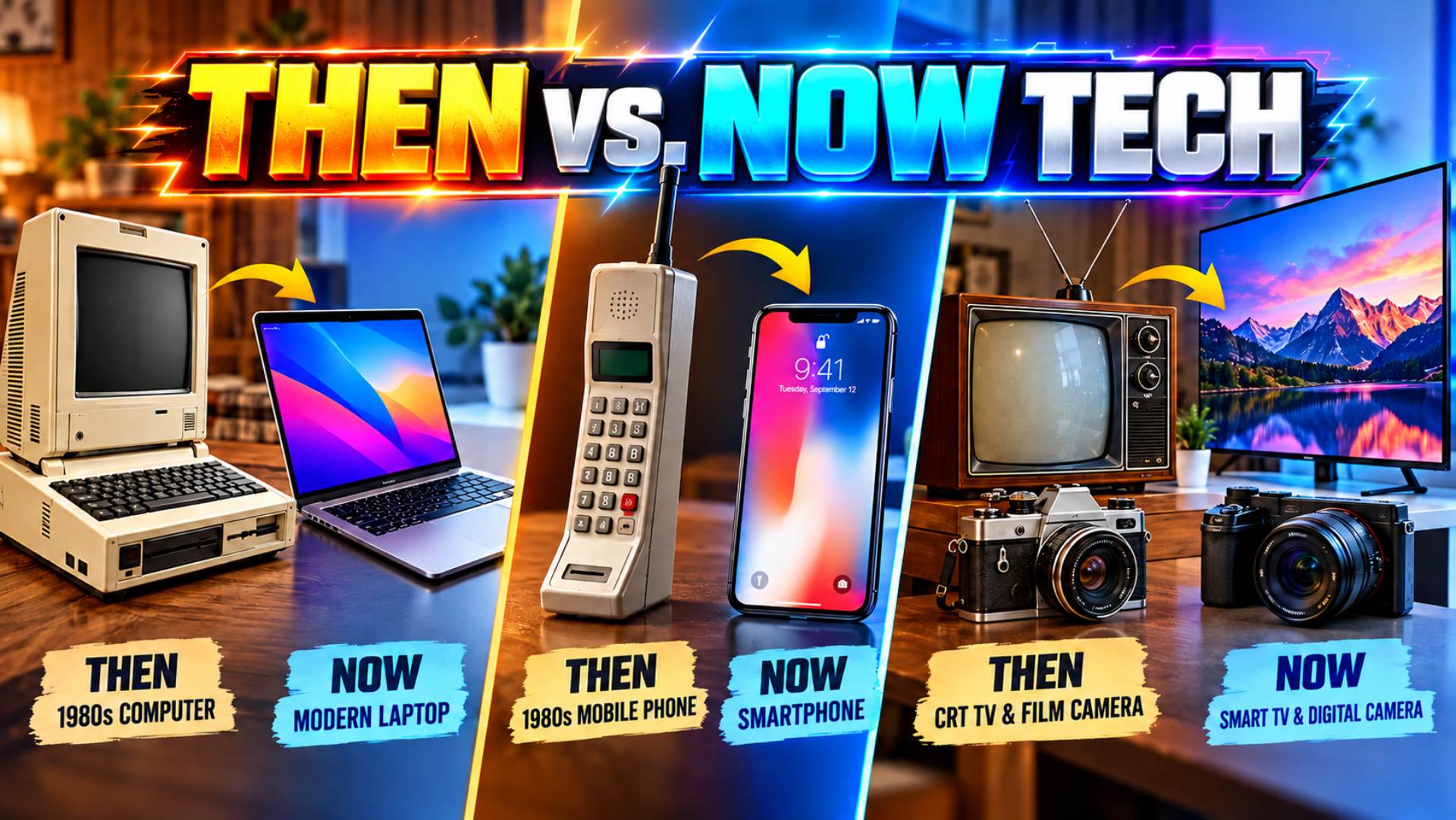
In the 1980s, a typical day might involve rewinding a cassette, dropping off a roll of film, waiting by the phone for a call, and unfolding a paper map that never folded back the right way. Today, all of that fits in a device that slips into your pocket.
The change has been so gradual that it is easy to forget how dramatic it is. Tasks that once took days, specialized equipment, or a trip across town now happen in seconds.
This look at Everyday Tech Then and Now puts the two eras side by side, showing how music, photos, phones, maps, entertainment, and information have changed since the 1980s., what we gained along the way, what we may have lost, and where everyday technology could be heading next.
Quick Answer
Everyday technology has changed from a collection of separate, physical devices into a connected digital ecosystem. In the 1980s, people relied on cassettes, film cameras, landlines, paper maps, VCRs, and standalone computers. Today, a smartphone can replace most of those tools while also providing instant access to streaming, GPS, messaging, search, photography, and AI assistance.
The biggest shift is convergence, speed, and connectivity. Technology is now faster, more portable, and easier to access, but this convenience has also brought trade-offs such as less privacy, reduced ownership of media, more distractions, and fewer shared experiences.
1980s vs. Today at a Glance
Here is a quick snapshot of how Technology Since the 1980s has changed across everyday activities such as music, photography, communication, entertainment, and navigation. Each category is explored in more detail below.
| Everyday task | 1980s | Today |
|---|---|---|
| Listening to music | Vinyl, cassettes, Walkman, early CDs | Streaming apps, wireless earbuds, smart speakers |
| Taking photos | Film cameras, limited shots, days to develop | Smartphone cameras, unlimited shots, instant sharing |
| Making calls | Landlines, pay phones, rare and bulky mobile phones | Smartphones with calls, video, and messaging apps |
| Getting directions | Paper maps, road atlases, asking for help | GPS navigation with live traffic and voice guidance |
| Watching movies | TV schedules, VHS tapes, video rental stores | On-demand streaming on any screen |
| Finding information | Encyclopedias, libraries, phone books | Search engines and AI assistants |
| Sending a message | Letters, postcards, answering machines | Texts, email, and instant messaging |
Music: From Mixtapes to Streaming
Then
Music in the 1980s was physical. People bought vinyl records and cassettes, and the compact disc arrived early in the decade as a premium new format. Sony’s Walkman, launched in 1979, made personal, portable music a part of daily life.
Discovering new music usually meant listening to the radio, watching music TV, or borrowing a friend’s album. Making a mixtape took real effort: waiting by the radio to record a song, or carefully timing tracks from records onto a blank cassette.
Now
Today, streaming services offer enormous music libraries for a monthly subscription, or free with ads. Algorithms suggest new songs based on what you already like, and playlists can be shared instantly. Wireless earbuds and smart speakers mean music follows you from room to room.
What changed most
The Evolution of Everyday Technology changed music from something people physically owned into something they increasingly access on demand. In the ’80s, your collection was limited to what you could buy and store. Now, almost any song is a search away, though fewer people own their music outright. Interestingly, vinyl has made a comeback, as many listeners miss the ritual of a physical record.
Photos: From Film Rolls to Smartphone Cameras
Then
Taking a photo in the 1980s meant loading a roll of film, often with 24 or 36 exposures. You could not see your pictures until the roll was developed, which might take days. Every shot cost money, so people saved them for birthdays, holidays, and special occasions.
Prints went into albums or shoeboxes, and sharing a photo meant handing it to someone or mailing a copy.
Now
Smartphone cameras let you take as many photos as you want, review them instantly, and delete the ones you do not like. Built-in editing, portrait effects, and night modes produce results that once required professional gear. Photos are shared with friends and family worldwide within seconds.
AI has added another layer. Phones automatically enhance images, and AI tools can restyle a modern selfie to look like it was taken decades ago, as the viral retro photo trend shows.
What changed most
Comparing 1980s Technology vs Today is especially striking in photography, where photos went from rare and precious to constant and abundant. That freedom is a huge creative gain, but it also explains why many people now crave the slower, imperfect charm of film.
Phones: From Landlines to Smartphones
Then
Most homes in the 1980s had a landline, often a single shared phone in the kitchen or hallway, with a cord that limited how far you could wander. If you were out, you used a pay phone. Answering machines, which became more common during the decade, meant you no longer had to wait at home for an important call.
Mobile phones did exist. Motorola’s DynaTAC 8000X, released in 1983, is widely recognized as the first commercial handheld mobile phone. But early mobiles were large, expensive, had short battery life, and were mainly used by businesspeople.
Now
Today’s smartphones are cameras, music players, maps, wallets, televisions, and computers in one device. Calls are only a small part of what they do. Messaging apps, video calls, and social media keep people connected constantly, wherever they are.
What changed most
One of the clearest examples of How Technology Has Changed is the phone moving from a fixed place to a personal device. In the ’80s, you called a house. Today, you reach an individual directly, at almost any time. That convenience brings a new challenge: managing screen habits and learning when to switch off.
Maps and Navigation: From Paper Maps to GPS
Then
Getting somewhere new in the 1980s took planning. Drivers kept road atlases in the glove box, studied paper maps before setting off, or wrote down directions given over the phone. A wrong turn often meant pulling over, checking the map again, or asking a stranger for help.
GPS existed during the decade, but it was a developing military system, not something people used in everyday life.
Now
Navigation apps offer turn-by-turn voice guidance, live traffic updates, public transit routes, walking directions, and estimated arrival times. They suggest faster routes on the fly and show nearby restaurants, gas stations, and stores along the way.
What changed most
Modern Technology Compared to the 1980s has made navigation almost effortless, while maps have evolved from route-planning tools into ways to find businesses, services, reviews, and nearby places. A search for “pizza near me” now combines location, reviews, and opening hours in one result. The trade-off is that many people rely on their phones so heavily that they rarely build a mental map of the places they travel.
TV, Movies, Computers, and Finding Information
Television and movies
In the 1980s, you watched shows when they aired, or recorded them on a VCR if you remembered to set the timer. Movies came from theaters or the video rental store, where a popular new release could be checked out before you arrived.
Today, streaming platforms let you watch what you want, when you want, on a TV, laptop, tablet, or phone. Entire seasons arrive at once, and recommendations are tailored to your viewing habits.
Computers
Personal computers entered homes during the 1980s, with machines like the IBM PC in 1981 and Apple’s Macintosh in 1984. They were mainly used for word processing, simple games, and learning to code, and most were not connected to anything.
Looking at Everyday Gadgets Through the Years, computing has moved far beyond the desktop and is now built into laptops, phones, watches, cars, and home appliances, almost all connected to the internet.
Finding information
Answering a question in the ’80s might mean flipping through an encyclopedia, visiting the library, or calling someone who might know. Finding a local business meant opening the phone book.
Today, search engines deliver answers in seconds, and AI assistants can summarize information, compare options, and answer follow-up questions in plain language. The challenge has shifted from finding information to judging which sources to trust.
What We Gained, and What We Lost
The History of Everyday Technology shows that progress is rarely all upside. Looking at both sides helps explain why ’80s nostalgia remains so strong today.
What we gained
- Speed and convenience. Tasks that took days now take seconds.
- Access. Music, movies, maps, and knowledge are available almost anywhere.
- Connection. Staying in touch with people across the world is simple and often free.
- Creativity. Anyone can take, edit, and share high-quality photos, videos, and music.
- Opportunity. Small businesses can reach customers globally through search, maps, and social media.
What we lost
- Anticipation. Waiting for photos, songs on the radio, or a weekly TV episode made moments feel special.
- Ownership. Many people now rent access to music and movies rather than owning them.
- Focus. Constant notifications make it harder to stay present.
- Privacy. Connected devices collect far more data about daily life.
- Shared experiences. Fewer people watch or hear the same thing at the same time.
That sense of loss is a big part of why retro trends, from vinyl to film cameras to AI-generated ’80s photos, keep growing in popularity.
What the Next 40 Years Might Bring
Tech Changes Over the Decades have repeatedly produced outcomes that were difficult to predict. No one in 1985 could have accurately imagined today’s smartphone, and forecasting the next four decades is just as uncertain.
- AI as an everyday assistant. Instead of opening separate apps, people increasingly ask AI tools to find, compare, plan, and summarize for them.
- Less screen, more voice and context. Devices may rely more on conversation, wearables, and awareness of your surroundings.
- Smarter search and discovery. Finding a business, product, or answer is shifting from scrolling through links to receiving direct recommendations.
- A continued appetite for analog. As technology grows more seamless, interest in tangible, imperfect experiences is likely to remain.
These are reasonable expectations based on where technology is moving, not certainties. The only safe bet is that the gap between 2026 and 2066 will feel just as wide as the one between 1986 and today.
Frequently Asked Questions
What technology was popular in the 1980s?
Popular technology included the Sony Walkman, cassette tapes, early CD players, VCRs, home video game consoles, arcade machines, answering machines, and early personal computers such as the IBM PC and Apple Macintosh.
Did mobile phones exist in the 1980s?
Yes. The Motorola DynaTAC 8000X, released in 1983, is widely recognized as the first commercial handheld mobile phone. Early mobiles were large, costly, and used mostly by business professionals.
How did people find directions before GPS?
They used paper maps, road atlases, written directions, landmarks, and help from locals. Planning a route before setting off was a normal part of travel.
What is the biggest difference between ’80s tech and today?
Convergence. In the 1980s, each task needed a separate device: a camera, a Walkman, a phone, a map. Today, one smartphone does all of these and much more.
Why are people nostalgic for ’80s technology?
Many people miss the tangible, slower, and more shared experiences of the era, such as physical media, waiting for photos, and watching shows at the same time as everyone else.
Final Thoughts: Four Decades in Your Pocket
Looking From 1980s Tech to Today, the two eras can feel like different worlds. Music, photos, phones, maps, movies, and information have all moved from separate, physical tools to a single connected device. What once took effort, patience, and planning now happens almost instantly.
Yet the most interesting part of the story may be what people still want from the past: tangible experiences, a little anticipation, and moments that feel shared.
For businesses, the biggest shift is how customers find you. In the ’80s, it was the phone book. Today, it is search engines, maps, and increasingly AI assistants. At Megrisoft, we help brands stay visible through SEO, local listings, and AI search optimization. If you want customers to find you as easily as they find directions, get in touch with our team.