
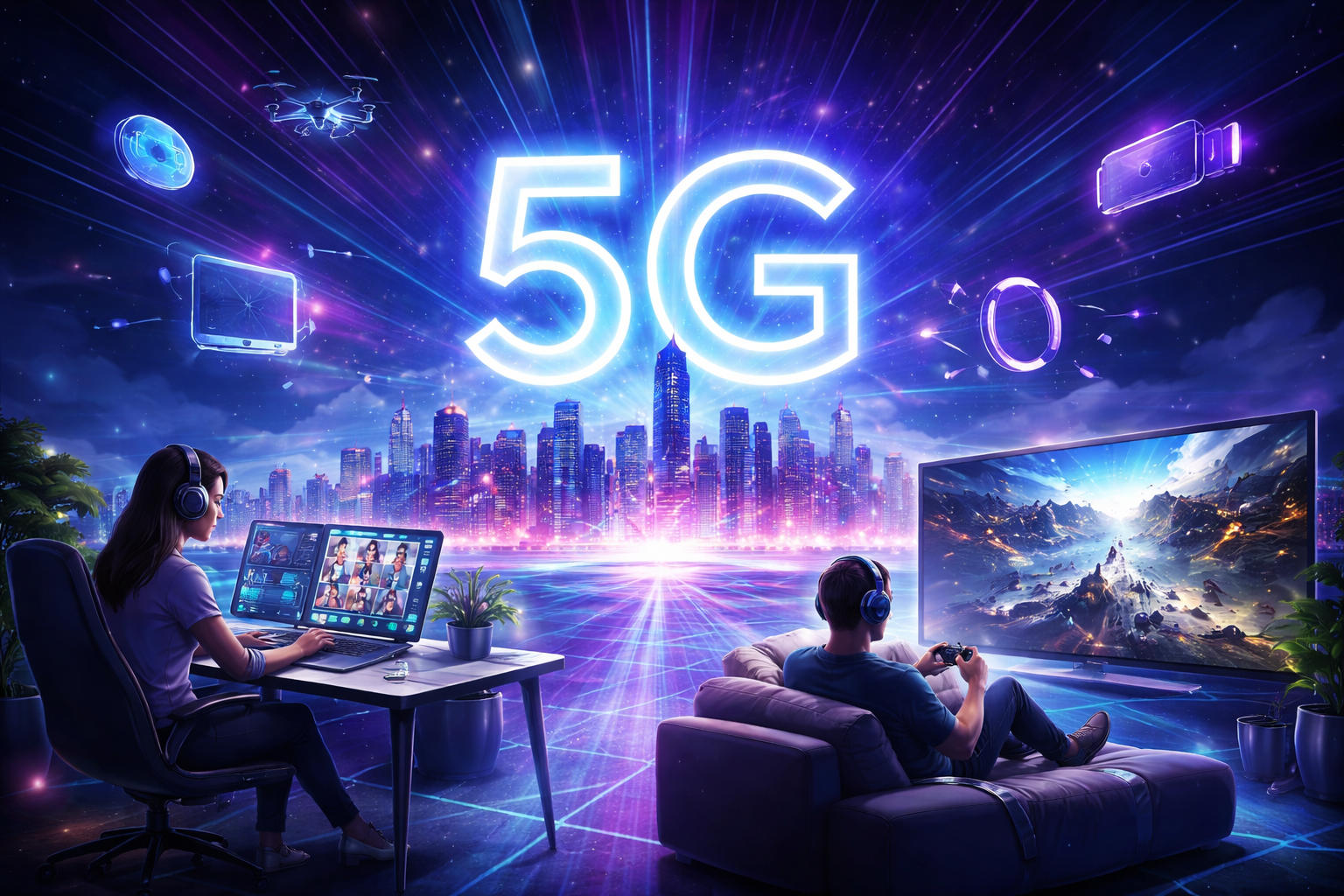
The digital world is entering a new phase—one defined not merely by faster connections, but by persistent, high-performance connectivity that reshapes how people work, communicate, and consume entertainment. Ultra-fast internet, powered by 5G networks and the technologies that will follow, is transforming expectations around speed, reliability, and responsiveness. What once felt innovative—remote work, cloud collaboration, live streaming—has become standard. What is changing now is the quality and scope of those experiences.
As homes become offices, entertainment becomes interactive, and businesses operate across time zones, network performance has become a foundational economic and cultural factor. Connectivity no longer supports digital life—it actively shapes it. This article examines how 5G and future ultra-fast internet technologies are redefining remote work, entertainment, communication, productivity, and innovation, while also exploring what lies beyond today’s networks and why these changes matter at both individual and societal levels.
The Evolution of Internet Speed and Connectivity
From Fixed Broadband to Always-On Mobility
For decades, internet performance depended largely on fixed-line infrastructure. Cable, DSL, and fiber connections defined what users could do online, while mobile networks served as secondary, lower-capacity alternatives. This separation influenced work patterns, entertainment habits, and device design.
The emergence of 5G fundamentally changes this model. High-speed connectivity is no longer tied to a physical location. Instead, it becomes portable, scalable, and consistently available, allowing users to transition seamlessly between environments without compromising performance.
Why Speed Alone Is Not the Whole Story
While raw speed often dominates discussion, latency, stability, and capacity are equally important. Ultra-fast internet delivers:
- Low latency, enabling real-time interaction
- High reliability, reducing service interruptions
- Massive bandwidth, supporting multiple simultaneous users and devices
Together, these characteristics enable applications that were previously impractical or unreliable, especially in mobile and remote contexts.
What Makes 5G a Transformational Technology
Architectural Differences from Previous Networks
5G is not simply an upgrade of 4G. It introduces a new network architecture designed to handle diverse and demanding use cases. Key technical advancements include:
- Network slicing, allowing customized performance for different applications
- Edge computing, processing data closer to the user
- Massive MIMO, improving efficiency and capacity
These features allow networks to adapt dynamically, ensuring optimal performance for work tools, entertainment platforms, and emerging technologies.
Capacity for Scale and Density
Modern digital life involves many connected devices per user, from smartphones and laptops to smart TVs and wearables. 5G networks are built to handle dense environments—offices, apartment complexes, stadiums—without congestion, ensuring consistent performance even during peak demand.
Beyond 5G: The Road Toward Next-Generation Networks
What “Beyond 5G” Really Means
The phrase beyond 5G refers to a collection of advancements that extend current capabilities rather than replace them outright. These developments focus on:
- Extreme data speeds, potentially hundreds of gigabits per second
- Near-zero latency, approaching real-time responsiveness
- AI-managed networks, optimizing traffic automatically
These technologies aim to support experiences that feel instantaneous and immersive, reducing the perceptual gap between physical and digital interaction.
The Vision of 6G Connectivity
Although still in research phases, 6G concepts suggest a future where connectivity supports:
- Holographic communication
- Fully immersive virtual environments
- Continuous integration between physical and digital systems
While widespread adoption remains years away, current infrastructure decisions are already laying the groundwork.
The Transformation of Remote Work
Remote Work as a Permanent Model
Remote work is no longer an exception. It has become a strategic operating model for organizations across industries. Ultra-fast internet enables this shift by removing friction from daily workflows.
With high-speed, low-latency connectivity, employees can participate fully in digital workplaces without performance constraints. This consistency supports productivity, collaboration, and employee satisfaction.
Real-Time Collaboration Without Compromise
Modern work depends on simultaneous interaction with shared digital resources. Ultra-fast internet ensures:
- Instant file synchronization
- Smooth screen sharing
- High-quality video meetings
These improvements reduce misunderstandings, shorten feedback loops, and support more natural communication across distributed teams.
Mobility and Location Independence
5G allows professionals to work effectively outside traditional office environments. Whether at home, in transit, or on-site with clients, workers can access enterprise systems securely and reliably.
This mobility expands talent pools for employers and gives individuals greater control over how and where they work.
Cloud Computing as the Backbone of Modern Work
Always-Available Applications
Cloud platforms underpin most business operations. Ultra-fast internet enhances their effectiveness by delivering near-instant access to applications and data.
This reduces dependence on local hardware and allows organizations to scale infrastructure dynamically based on demand.
Security and Centralized Control
With data stored and managed centrally, organizations can implement stronger security frameworks while still enabling remote access. High-performance connectivity ensures encryption, authentication, and monitoring processes run without introducing delays.
Business Productivity in the Ultra-Fast Era
Accelerated Decision-Making
In data-driven organizations, speed of insight matters. Ultra-fast internet supports real-time analytics, enabling leaders to respond quickly to operational changes and market conditions.
This responsiveness improves efficiency and reduces the cost of delayed decisions.
Supporting Advanced Enterprise Technologies
5G networks provide the foundation for technologies that depend on constant data exchange, including:
- Predictive analytics
- Automated workflows
- Remote monitoring systems
These tools increase accuracy, reduce manual effort, and improve scalability.
Communication Redefined by Ultra-Fast Internet
Video as the Primary Business Medium
Text-based communication is increasingly supplemented—or replaced—by video. Ultra-fast internet enables high-definition, low-latency video interactions that feel more personal and engaging.
This shift improves trust, collaboration, and clarity in professional relationships.
Toward Immersive Communication
Future networks will support spatial audio, mixed reality meetings, and real-time translation, reducing barriers between participants regardless of location.
The Reinvention of Digital Entertainment
Entertainment has always evolved alongside technology. From broadcast television to on-demand streaming, each leap in connectivity has reshaped how content is created and consumed. Ultra-fast internet marks the next major shift, moving entertainment beyond passive consumption toward interactive, immersive, and personalised experiences.
Unlike previous generations, 5G and future ultra-fast networks remove performance bottlenecks that once limited quality and responsiveness. This enables richer formats, higher resolutions, and real-time interaction across devices and platforms.
Streaming in the Ultra-Fast Internet Era
The End of Buffering and Compromise
Streaming services now compete on experience rather than access. Ultra-fast internet enables uninterrupted playback, even for bandwidth-intensive formats such as 4K and emerging 8K content.
For users, this means:
- Immediate playback without loading delays
- Stable quality regardless of network congestion
- Seamless switching between devices
Streaming becomes predictable and reliable, removing friction from everyday entertainment.
Live Streaming and Real-Time Events
Live content places unique demands on networks. Sports broadcasts, concerts, and live creator streams require consistent low latency to maintain engagement. Ultra-fast internet ensures that live experiences remain synchronized, interactive, and visually sharp.
This reliability supports:
- Real-time audience participation
- Interactive live features such as polling and chat
- Global access to time-sensitive events
Gaming Transformed by Ultra-Fast Connectivity
Why Latency Matters in Gaming
Gaming is among the most demanding digital activities. Even minor delays can disrupt gameplay, particularly in competitive environments. Ultra-fast internet dramatically reduces latency, improving responsiveness and fairness.
This benefits:
- Competitive multiplayer gaming
- Real-time strategy and action titles
- Cooperative online experiences
Players experience tighter control and smoother interactions, regardless of location.
The Rise of Cloud Gaming Platforms
Cloud gaming shifts processing from local devices to remote servers. With traditional networks, latency and instability limited its appeal. 5G changes this equation by enabling near-instant input response.
As a result:
- High-end games become accessible on modest devices
- Hardware costs for users decrease
- Gaming becomes more platform-agnostic
This model expands access and reshapes how games are distributed and monetised.
Mobile Gaming Reaches Console-Level Quality
Mobile gaming has grown rapidly, but performance constraints remained. Ultra-fast internet allows mobile devices to deliver console-quality visuals and responsiveness, narrowing the gap between mobile and traditional gaming platforms.
Virtual Reality and Augmented Reality Experiences
Connectivity as the Missing Link
VR and AR technologies require continuous, high-speed data exchange. Ultra-fast internet supports these requirements, reducing motion lag and improving visual stability.
This enables:
- More immersive virtual environments
- Social VR experiences with multiple participants
- Location-based AR entertainment
As network performance improves, VR and AR move closer to mainstream adoption.
Entertainment Beyond the Screen
Ultra-fast internet allows entertainment to extend into shared virtual spaces, including virtual concerts, exhibitions, and interactive storytelling. Audiences move from spectators to participants, shaping experiences in real time.
Everyday Entertainment in a Multi-Device World
Simultaneous Usage Without Degradation
Modern households often run multiple high-bandwidth activities at once. Ultra-fast internet ensures that streaming, gaming, video calls, and smart devices operate simultaneously without performance loss.
This consistency supports:
- Shared households with diverse usage patterns
- Remote work alongside entertainment
- Smart home integration
Personalized, Data-Driven Content Experiences
Streaming and entertainment platforms increasingly rely on real-time analytics. Ultra-fast internet supports dynamic personalisation, allowing content recommendations and interfaces to update instantly based on user behaviour.
This responsiveness improves engagement while giving users more relevant options.
Smart Homes and Connected Entertainment Ecosystems
The Role of Ultra-Fast Internet in Smart Living
Smart homes rely on constant communication between devices. Ultra-fast internet ensures that voice assistants, streaming hubs, lighting systems, and entertainment controls respond instantly.
This creates:
- More intuitive home environments
- Integrated entertainment experiences
- Reduced technical friction
Connectivity becomes an invisible enabler rather than a point of failure.
Voice, Gesture, and Ambient Interfaces
As bandwidth and responsiveness improve, entertainment interfaces evolve. Voice commands, gesture controls, and ambient computing rely on fast network feedback to feel natural.
These interfaces blur the line between technology and environment, making entertainment more accessible and inclusive.
Cultural Shifts Driven by Ultra-Fast Internet
Entertainment as a Shared Digital Experience
Ultra-fast internet supports collective digital moments, where audiences engage simultaneously across platforms and locations. Shared viewing, live reactions, and social integration become central to entertainment culture.
This strengthens:
- Online communities
- Creator–audience relationships
- Global participation in cultural events
The Blending of Work, Leisure, and Creativity
As performance constraints fade, boundaries between professional tools and entertainment platforms soften. Skills developed in gaming, streaming, or virtual collaboration increasingly overlap with workplace competencies.
Creativity, communication, and technical literacy become transferable across domains.
The Economics of Ultra-Fast Entertainment
New Revenue Models and Opportunities
Ultra-fast internet enables subscription-based, interactive, and virtual-event-driven business models. Creators and platforms monetise experiences rather than static content.
This includes:
- Live virtual events
- Premium interactive features
- Digital goods and environments
Lower Barriers for Creators
Improved connectivity reduces the technical hurdles for content creation. Independent creators can stream, collaborate, and distribute high-quality content without costly infrastructure.
This democratisation expands creative diversity and innovation.
Challenges and Considerations in the Entertainment Landscape
Infrastructure and Access Gaps
Despite progress, access to ultra-fast internet remains uneven. Rural and underserved regions may struggle to benefit fully from advanced entertainment experiences.
Addressing these gaps is essential to prevent digital exclusion.
Data Usage and Privacy
High-bandwidth entertainment generates vast amounts of data. Responsible data management and transparent privacy practices are critical to maintaining user trust in an always-connected environment.
Infrastructure Behind Ultra-Fast Internet
Building the Foundations of High-Speed Connectivity
Ultra-fast internet does not emerge by chance. It relies on extensive physical and digital infrastructure, including dense networks of small cells, fiber backhaul, edge data centres, and advanced spectrum management. Unlike earlier generations, 5G requires closer proximity between network nodes and users, particularly in urban and high-demand environments.
This infrastructure investment is substantial, but it is also strategic. Governments and private providers increasingly view ultra-fast connectivity as critical national infrastructure, comparable to transport networks or power grids. Reliable digital access now underpins economic resilience, innovation, and global competitiveness.
Rural Connectivity and Infrastructure Gaps
Despite rapid progress, infrastructure deployment remains uneven. Rural and remote areas often face challenges due to lower population density and higher installation costs. Without targeted investment, these regions risk being excluded from the full benefits of ultra-fast internet.
Closing this gap requires:
- Public–private partnerships
- Policy incentives for rural deployment
- Hybrid models combining fiber, wireless, and satellite connectivity
Ensuring broad access is essential to prevent long-term digital inequality.
Digital Equity and Accessibility
Ultra-Fast Internet as an Economic Enabler
Access to high-speed connectivity increasingly determines access to opportunity. Remote work, online education, digital entrepreneurship, and entertainment ecosystems all depend on reliable internet performance. Where ultra-fast internet is available, individuals and communities gain greater flexibility, resilience, and economic participation.
Conversely, limited connectivity can restrict job options, reduce access to services, and widen socioeconomic divides. Digital equity is therefore not only a technical issue but also a social and economic priority.
Inclusive Design and Accessibility
Beyond access, usability matters. Ultra-fast internet enables more inclusive digital experiences, including:
- Real-time captions and translations
- High-quality assistive technologies
- Adaptive interfaces for different abilities
These features improve participation for people with disabilities, language barriers, or mobility constraints, making digital environments more inclusive.
Security and Privacy in an Ultra-Connected World
Expanding Attack Surfaces
As connectivity increases, so does complexity. Ultra-fast networks support billions of connected devices, expanding the potential attack surface for cyber threats. Remote work tools, cloud platforms, and entertainment services all rely on continuous data exchange, making robust security frameworks essential.
Organizations and service providers must prioritise:
- End-to-end encryption
- Secure authentication protocols
- Continuous monitoring and threat detection
Privacy in High-Bandwidth Environments
Ultra-fast internet enables richer data collection, particularly in entertainment and personalised services. While this improves user experience, it also raises privacy concerns. Transparent data practices, user control, and regulatory compliance are critical to maintaining trust.
Consumers increasingly expect:
- Clear data usage policies
- Meaningful consent mechanisms
- Protection against misuse or over-collection
The Long-Term Societal Impact of Ultra-Fast Internet
Changing Work–Life Structures
Ultra-fast internet supports more flexible work arrangements, allowing people to integrate professional responsibilities with personal life more effectively. This shift can reduce commuting, expand geographic choice, and support healthier routines when managed responsibly.
However, it also requires clear boundaries and digital well-being practices to prevent overwork and constant connectivity.
Creativity, Culture, and Global Exchange
High-performance connectivity accelerates cultural exchange. Artists, educators, and creators collaborate across borders in real time, sharing ideas and reaching global audiences. Entertainment becomes more diverse, interactive, and reflective of global perspectives.
Ultra-fast internet acts as a catalyst for shared creativity, lowering barriers to entry and amplifying voices that were previously constrained by technical limitations.
Innovation Beyond 5G
Intelligent, Self-Optimising Networks
Future networks will increasingly rely on artificial intelligence to manage traffic, predict demand, and allocate resources dynamically. These intelligent systems improve efficiency and resilience while reducing manual intervention.
Such automation ensures consistent performance even as usage patterns fluctuate.
Seamless Integration Into Daily Life
As connectivity improves, it becomes less visible. Ultra-fast internet fades into the background, supporting experiences without drawing attention to itself. Work, entertainment, and communication feel immediate and intuitive rather than mediated by technology.
This invisibility marks the true maturity of digital infrastructure.
Frequently Asked Questions (FAQ)
How does ultra-fast internet fundamentally change remote work productivity?
Ultra-fast internet improves remote work productivity by removing delays that disrupt focus and collaboration. High-speed, low-latency connections allow seamless video meetings, instant access to cloud-based tools, and real-time collaboration on shared documents. This reduces downtime, improves communication clarity, and enables distributed teams to operate with efficiency comparable to—or exceeding—that of traditional office environments.
Why is latency more important than speed for gaming and interactive entertainment?
Latency determines how quickly data travels between a user and a server. In gaming and interactive entertainment, even small delays can affect responsiveness and immersion. Ultra-fast internet significantly reduces latency, ensuring that player inputs, visual updates, and interactions occur almost instantly. This creates smoother gameplay, fairer competition, and more immersive experiences across cloud gaming and multiplayer platforms.
Can ultra-fast internet replace traditional cable and satellite entertainment services?
Ultra-fast internet has the potential to replace many traditional broadcast services by supporting high-quality, on-demand streaming and live content delivery. Unlike cable or satellite, internet-based platforms offer flexibility, personalisation, and interactive features. However, full replacement depends on coverage consistency, pricing models, and consumer preferences, particularly in regions with limited high-speed infrastructure.
How does 5G support emerging technologies like virtual and augmented reality?
Virtual and augmented reality require continuous, high-volume data transfer with minimal delay. Ultra-fast internet provides the bandwidth and low latency necessary to render immersive environments smoothly and responsively. This enables applications such as virtual collaboration spaces, immersive entertainment, training simulations, and social VR experiences that feel natural and engaging rather than disorienting or lag-prone.
What role does ultra-fast internet play in business innovation and competitiveness?
Ultra-fast internet enables businesses to adopt advanced digital tools, streamline operations, and respond quickly to market changes. Real-time analytics, cloud computing, remote collaboration, and automation all depend on reliable connectivity. Organizations with access to ultra-fast networks can innovate faster, scale more efficiently, and compete more effectively in increasingly digital global markets.
What are the main risks associated with widespread ultra-fast connectivity?
The primary risks include cybersecurity threats, data privacy concerns, and unequal access. As more devices and services rely on constant connectivity, security vulnerabilities can increase if not properly managed. Additionally, uneven infrastructure deployment may widen digital divides. Addressing these risks requires strong security practices, transparent data policies, and inclusive infrastructure investment.
What comes after 5G, and how soon will it affect everyday users?
Beyond 5G and early 6G technologies aim to deliver even lower latency, higher speeds, and intelligent network management. While mass adoption may take several years, incremental improvements will appear gradually through enhanced 5G deployments. Over time, these advances will support immersive communication, smarter cities, and digital experiences that feel increasingly seamless and immediate.
Final Conclusion
Ultra-fast internet, driven by 5G and future network technologies, represents a foundational shift in how people work, communicate, and experience entertainment. It eliminates many of the technical constraints that once shaped digital behaviour, enabling more flexible work models, richer entertainment formats, and deeper global collaboration.
As connectivity continues to evolve, its true value lies not in raw speed but in how effortlessly it supports human activity. Organizations, creators, and individuals who understand and adapt to this shift will be best positioned to thrive in a future where digital and physical experiences are increasingly intertwined.